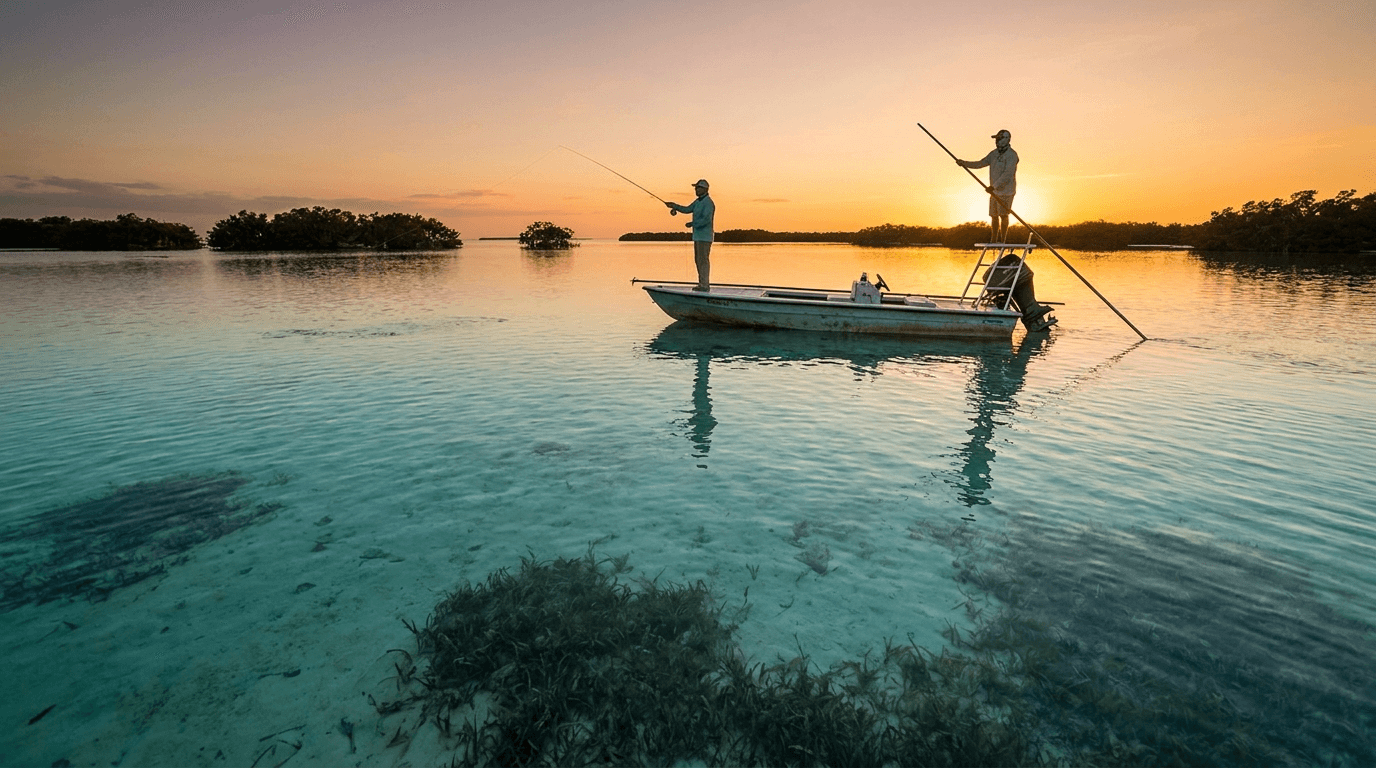
A bonefish doesn't swim into view so much as it materializes. One second the flat ahead of the skiff is just glare and turtle grass. The next there's a shadow with a tail poking out of six inches of water, feeding nose-down like it's trying to drink the bottom of the ocean. Blink and it's gone — a silver contrail across the shallows, spooked by a footstep on the deck or a shadow crossing the sun. That single-shot pressure is the whole sport, and it's why booking a bonefish trip in the Florida Keys runs on different math than booking a mahi run offshore or a redfish trip in a Louisiana marsh.
When Bonefish Actually Show Up
Bonefish live on the Keys flats year-round, but they don't show up evenly, and the calendar shifts depending on which stretch of the Keys you're fishing. Guides working the Key West flats generally point to August through October as the strongest run of tailing fish, with good fishing continuing into the first cold fronts of late fall. Guides in Islamorada and the upper and middle Keys run on a slightly different clock — spring and fall both produce, while the dead-calm heat of midsummer pushes the best action into the first few hours after sunrise.
| Season | What's happening on the flats |
|---|---|
| Winter (Dec–Feb) | Cold fronts push fish off the skinniest flats into deeper edges; fewer tailing shots, more sight-fishing in three to four feet of water |
| Spring (Mar–May) | Building numbers as water warms; comfortable temperatures make for full-day fishing |
| Summer (Jun–Aug) | Calm, glassy conditions make fish easy to spot, but heat means the best window closes by early afternoon |
| Fall (Sep–Nov) | Widely considered prime time in the Lower Keys — thick tailing activity before winter fronts start rolling through |
None of that means a January trip is wasted. It means a good guide adjusts where he poles and how early he starts, and a first-time bonefish angler should ask exactly that question before booking: where are we fishing this month, and why there?
What a Bonefish Charter Actually Costs
Bonefish trips run a wider price band than most inshore fisheries for one simple reason: it's almost always one guide, one skiff, one or two anglers. There's no six-pack boat spreading the day rate across six paying clients. You're renting one person's eyesight and one person's pole for six to eight hours, and the rate reflects that.
| Trip length | Typical rate (1–2 anglers) |
|---|---|
| Half day (~4 hrs) | $450–$550 |
| 3/4 day (~6 hrs) | $550–$650 |
| Full day (~7–8 hrs) | $650–$1,000 |
| Peak-season weekend (some Upper Keys guides, March–June, Sat/Sun) | Up to $2,000 |
That last row is real, sourced from a Keys operator's own published rate sheet, and it's worth flagging as the outlier it is: a premium weekend surcharge during the busiest stretch of the season, not a typical day rate. Most full-day bookings land in the $650–$900 range depending on the guide's reputation and how far you are from Key West versus Islamorada.
Deposits run 20 to 33 percent of the trip cost, due at booking, and they're commonly non-refundable once you're inside the cancellation window — often 10 days out. A few Islamorada operations charge a flat deposit (around $400) regardless of the total trip cost. Read the cancellation terms before you send money. Weather cancels flats trips constantly — wind kills sight-fishing faster than it kills an offshore troll — and you want to know in writing what happens to your deposit if the guide calls it, versus if you do.
The Real Total, Split Two Ways
Here's the number worth writing down before you call anyone, using a mid-range full-day rate of $650 for two anglers:
- $650 day rate ÷ 2 anglers = $325 each
- 20% deposit due at booking = $130 (non-refundable once you're past the cancellation window)
- Balance due dockside = $520
- Tip at 18% of the $650 rate = $117
Add the tip back in and split the whole trip evenly: ($650 + $117) ÷ 2 = $383.50 per angler. That's the real cost of the day, not the headline day rate — and there's one wrinkle worth knowing before you hand over cash on the dock. On an offshore boat with a captain and a mate, that tip usually splits between two people. On a bonefish skiff, there's one guide on the poling platform all day, so the full $117 goes to him.
Why the Cheapest "Backcountry" Listing Is Often the Wrong Call
Search any Keys marketplace for a backcountry charter and you'll get a wall of near-identical listings: bonefish, tarpon, permit, redfish, snook, all offered by the same boat at the same day rate. The standard advice is to compare prices and book whoever's available on your dates. For bonefish specifically, that advice is close to backwards.
Take a guide who runs $650 full days chasing whatever's willing to eat — snook around the bridges, a leftover permit school, redfish in the backcountry — against a guide charging the identical $650 who's built his whole season around one target: poling skinny water for tailing bonefish, six to eight hours at a stretch, month after month. The rate card looks the same. The day won't be.
A bonefish guide's real product isn't the boat. It's how good his eyes are, and how many hours a season he's spent training them on this one fish.
The tell is in how a guide's own site or listing talks about the fishery. "Backcountry charter — bonefish, tarpon, permit, snook, redfish" is a generalist's pitch, and there's nothing wrong with that for a mixed-bag day. But a guide whose bio leads with tailing fish, poling skiffs, and long casts on spinning or fly gear is telling you where his hours actually go. Ask directly how many bonefish-specific trips he ran last season versus everything else combined. A guide who dodges the question is probably a fine generalist. He's not who you book when bonefish is the whole point of the trip.
What the Day Actually Looks Like
Gear expectations are different from an offshore trip, and most first-timers get at least one thing wrong. Closed-toe shoes with a hard sole for the poling platform — not sandals, not bare feet. Muted colors, since a bright shirt against open sky can spook a fish from thirty yards out. Polarized sunglasses aren't optional; spotting a bonefish before it spots you is most of the job, and cheap non-polarized lenses turn glare into a wall you can't see through.
Most guides run a near-silent boat once they've spotted a fish and started poling into position — a low, clipped cadence of "two o'clock, sixty feet, moving left." First-timers who've only fished offshore sometimes read this as unfriendly. It isn't. A heavy footstep or a raised voice at the wrong second ends the shot, and a good guide would rather lose a little small talk than lose the fish.
Wading is common on some flats and off the table on others, depending on bottom composition and how the guide runs his trips — ask before you assume you'll be standing in the water at some point. And license requirements follow the same rule as most Florida charter fishing: confirm directly with the guide whether the boat's charter license covers you or whether you need your own Florida saltwater fishing license, since the answer can depend on the vessel and the season.
Booking It
Lock in dates you're actually sure of before sending a deposit — the non-refundable clock starts the moment you pay it, not the moment you show up. Get the trip length, the rate, and the cancellation policy confirmed over email or text before you wire anything, and don't assume a "backcountry" listing means bonefish specialization unless the guide's own words say so.
Once you've got the trip booked, the tipping math above holds regardless of season or region — for more on how that 15-to-20-percent standard works across different types of guided trips, the full breakdown on tipping a fishing guide covers the edge cases this piece didn't have room for. And if you're still deciding what kind of guide to vet before you call anyone, our list of questions to ask before booking works just as well for a bonefish specialist as it does for any other charter.