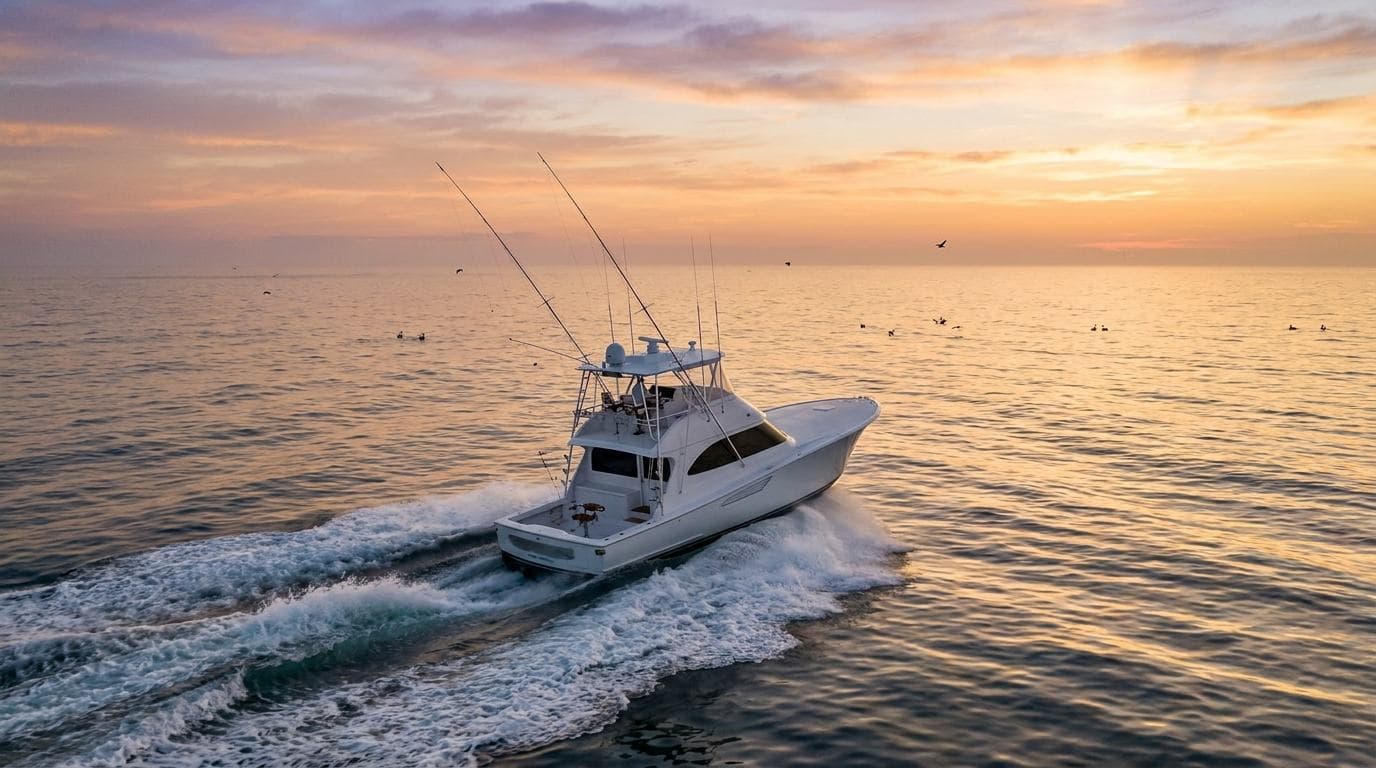
An inshore trip is forgiving. An offshore trip is not — not in terms of sea conditions, not in terms of how far from help you are, and not in terms of how a long, hot boat ride home feels when you showed up underprepared and got seasick an hour after the lines went in the water.
What follows is a walkthrough of what an offshore charter day actually looks like, what you're responsible for bringing and knowing, and what happens on the boat that surprises most first-timers.
If you haven't done any guided fishing yet and want to start smaller, the inshore charter guide is the better starting point. Offshore is a step up in duration, distance, and cost.
What "Offshore" Actually Means
Inshore fishing happens within a few miles of the coast — in bays, estuaries, flats, and tidal rivers. Offshore fishing starts at the edge of the continental shelf, anywhere from 20 to 100-plus miles from the dock depending on your location and target species. You'll be in open ocean, often out of sight of land, in water that behaves nothing like a bay.
The species change completely. Offshore targets include mahi-mahi (also called dolphin or dorado depending on who you're fishing with), wahoo, yellowfin and blackfin tuna, blue and white marlin, and sailfish. Depending on what the captain finds and what the group wants, you may also drop to the bottom on the way back in for grouper, snapper, and amberjack.
The fishing method is almost entirely different from anything you've done in freshwater or nearshore. Trolling is primary: the boat moves while lures or rigged baits trail behind on spread lines. When a fish strikes, a reel screams and someone grabs the rod. That's the core of the day.
The Night Before Matters More Than You Think
If you're prone to motion sickness — and plenty of people who have never been seasick on a bay boat find out the hard way that open ocean swells are different — the night before is when you handle it.
Dramamine and Bonine (meclizine) need time to work. Take your dose the evening before, not the morning of, and take a second dose when you wake up. By the time you feel ocean swells an hour from shore, the medication needs to already be in your system. The patch form of scopolamine, available by prescription, goes behind the ear the night before and lasts longer for extended trips. If you have a history of severe motion sickness and you're planning an eight-hour offshore day, talk to a doctor before you go.
Skip the heavy dinner and skip the alcohol the night before. Both increase nausea susceptibility on the water. This is not a minor variable — most cases of serious seasickness on offshore charters trace back to the night before, not to the conditions on the water.
What to Bring
The captain and mate provide tackle, bait, ice, and typically drinks and light snacks. They do not provide clothing, sun protection, or seasickness medication. Your packing list:
- Sunscreen, SPF 50 or higher. You will need to reapply, so bring enough. The sun offshore reflects off the water from every angle and the burn comes faster than on land.
- Polarized sunglasses. Glare on open water over a full day is severe.
- A hat with a brim — not a baseball cap with an open back.
- Non-slip rubber-soled shoes. No flip-flops, no bare feet on a moving, wet deck.
- Layers. The run out is often cold regardless of air temperature onshore. A windbreaker or light rain jacket cuts the spray during transit.
- A dry bag or resealable bag for your phone and wallet. Salt spray is constant offshore.
- Cash. More on why below.
Leave coolers, large bags, and anything you don't want soaked on shore. The deck of a working offshore charter is not a good place for fragile or bulky items.
The Day's Timeline
Most offshore trips out of Gulf Coast, East Coast, and Florida ports depart between 5:30 and 7:00 a.m. Your captain will ask you to be at the dock 30 minutes before departure. This matters — late arrivals hold up a crew that had the boat ready before sunrise and a captain watching a weather window that may not stay open all morning.
The run to the fishing grounds takes one to three hours depending on how far out the captain needs to go. This is not fishing time. It's bumpy, often cold, and the conditions you experience during the run are what you'll be dealing with all day. First-timers sometimes underestimate how different open ocean swells feel compared to anything they've been on before. Face forward, get some air, watch the horizon if your stomach is uncertain.
Once on the grounds, the mate rigs the spread — typically six to eight lines trailing lures or live baits at varying distances and depths behind the boat. The captain reads the water: temperature breaks, floating grass lines, bird activity. When a fish takes a lure, someone in the cockpit gets the rod. On a private charter with a small group, you'll each rotate on fish. On a shared or walk-on boat, rotation and etiquette matter more.
The mate handles baiting hooks, clearing tangles, coaching rod angle and drag technique, and gaffing or netting fish at the boat. Their job is constant and physically hard. The captain is up on the bridge navigating and looking for fish.
Bottom fishing, if it happens, usually comes in the afternoon on the run back in. The captain finds a reef or wreck in 80 to 200 feet, the mate drops weighted rigs to the bottom, and you work for grouper, snapper, and whatever else is holding there. It requires less running and is less physically demanding than trolling and often produces a better result for the fish box.
Most full-day offshore trips wrap up fishing around 2:00 to 3:00 p.m. and reach the dock between 4:00 and 5:00 p.m. after the run home. A half-day offshore trip, where available, typically runs four to six hours total.
At the Dock
The mate fillets the catch at the dock after the trip. This is part of the service and one of the things that distinguishes a charter from renting a boat yourself. Watch if you want — an experienced mate can process a box of mahi quickly and cleanly.
The catch is your property to take home within legal bag limits, which your captain tracks and manages. Bring a cooler with ice if you plan to take fish home, or ask your captain in advance whether they know a local processor. Confirm the fish rules when you book — regulations vary by species and season and your captain will know what's in play on that trip.
Tipping the mate is standard. The typical range is 15 to 20 percent of the total charter price, paid in cash at the dock after the trip. On a $1,200 half-day private charter, that's $180 to $240. On a full-day trip at $2,000, you're looking at $300 to $400 for strong service. On a shared boat where you paid a per-person rate, individual tips of $20 to $40 per person are the standard expectation.
On a private charter with both a captain and a mate, the tip primarily goes to the mate — they're the ones who worked the deck all day. A separate tip to the captain is a nice gesture but not the standard expectation unless the captain ran the whole trip solo.
Cash is the norm. Some operations accept digital payments for tips, but ask first rather than assume.
Get your photos at the dock while the fish are on ice or still on the gaff. The mate can help hold fish for shots. If you caught a billfish and released it — marlin and sailfish are almost always catch-and-release — get the photo immediately at the water, not later.
Things Nobody Tells You Before You Go
The boat smell is real. Diesel, bait, and salt combine on a warm afternoon into something that accelerates nausea. If you're already on the edge, staying below deck or near the engine compartment makes it worse. Stay at the stern or midship, face into the wind, and keep your eyes on the horizon.
You will not catch fish on every trip. On some days the bite is slow, the fish have moved, or the weather cooperated but the ocean didn't. Offshore fishing has real variance. A captain who promises specific catches is either working nearshore where the bite is more predictable or over-promising. Good captains give you honest expectations at the start of the trip.
Your fishing license is usually covered in the charter fee for federal waters, but check when you book. For state waters — generally within three miles of shore — some captains hold a party boat license that covers all passengers; others do not. Ask before you go.
If it's your first offshore trip and budget allows, book a private charter rather than a shared walk-on boat. You'll fish at your group's pace and get direct attention from the mate. A slow bite with strangers on a walk-on boat is a different experience than a slow bite with your own group where you can move around, ask questions freely, and decide together how to spend the back half of the day.
When you're comparing captains, look for the ones who specify their target species, what's included in the price, and how many anglers they take per trip — that level of detail is usually a reliable signal of a professional operation. For more before you book, browse the rest of the guides library.