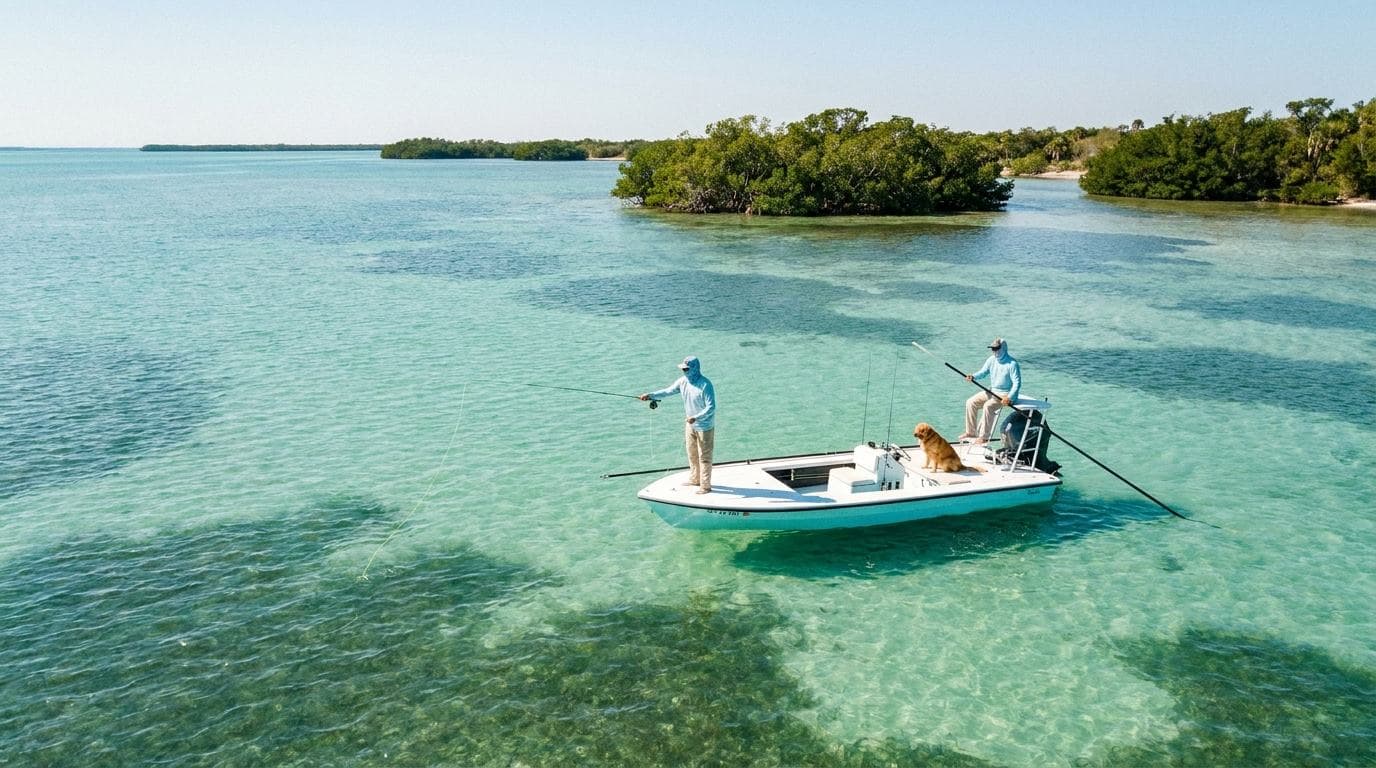
The flats skiff your captain poles sits in about eighteen inches of water. The fish you're targeting are twenty feet away, not twenty fathoms down. Inshore fishing is its own kind of saltwater experience, and understanding what it actually involves will help you show up prepared and get more out of the day.
Most inshore charters operate in water under 30 feet deep: tidal flats, oyster bars, mangrove creeks, grass flats, and the shallow bays that connect them. The boat is smaller than an offshore vessel, the ride from dock to fishing is short, and the environment is far calmer. For most people taking their first guided fishing trip, that combination makes inshore the better starting point.
What You're Fishing For
Species depend heavily on where you're fishing. On the Gulf Coast and Southeast Atlantic, inshore means redfish (red drum), spotted seatrout, and snook. Redfish push up onto grass flats and oyster bars on incoming tides. Trout hold in 3-to-6-foot water over grass. Snook hide in shade — under docks, against mangrove roots, in the shadows of bridges — and they test casting accuracy more than almost any other inshore species.
On the Mid-Atlantic and Northeast coast, inshore targets include striped bass, bluefish, weakfish, and flounder, sometimes all in the same morning. Pacific inshore fishing runs to halibut, kelp bass, and surfperch depending on the season. If you're booking and unsure whether the species list matches what you're picturing, ask the guide what's realistic for the time of year you're going. The answer tells you more about their knowledge than any review will.
What It Costs to Book
In 2026, an inshore half-day charter typically runs $300 to $600 for the boat, and that price covers the party — usually two to four anglers depending on the vessel — not per person. Full days run $600 to $900. Tackle, bait, ice, and fuel are in that number on almost every operation; a fish-cleaning fee occasionally isn't, so ask.
Expect to put down a deposit when you book. The norm is 20 to 30 percent of the trip price, or a flat $100 to $150 on some boats, with the balance due at the dock. Don't read the deposit as a nuisance — read it as information. A deposit is a filter, not a fee: it's how a captain keeps a serious calendar, and a captain whose dates are worth protecting is generally a captain worth booking. An operation that takes reservations with nothing down is telling you its calendar doesn't fill, and you should wonder why.
The Timeline of a Charter Day
Most inshore charters depart at or shortly after sunrise. Tides drive inshore fishing more than the clock does — an incoming tide pushing baitfish over a grass flat can produce a two-hour window that's more productive than the rest of the day combined. Your captain chose the departure time based on the tide, not convention. If they say be at the ramp by 6:15, be there by 6:05. Showing up late to an inshore charter wastes the window you paid for.
The boat is already rigged when you arrive. Rods are set, the livewell is running if live bait is part of the plan, tackle is organized. You don't need to touch any of it. The captain will go over a brief safety orientation, tell you where to stand while running, and explain the plan for the day: which areas, what species, what approach. That takes five minutes. Then you're running.
Once you're on the water, a typical session moves in rotations. Fish a spot for twenty or thirty minutes, then move. The captain is reading conditions the whole time — watching for birds working bait, looking at how the tide is moving through structure, watching the edges of the grass for nervous water. On a productive day, you'll work several different spots and see fish at most of them. On a slow day, the captain is working harder than you are, and you're still learning something.
Half-day trips run four to five hours. Full days run six to eight. For a first charter, book the half-day. Four hours of casting is more physical than it sounds, and the honest truth is that most of the action on a good inshore day happens in the first three hours when the tide is at peak. You'll leave wanting more, which is the right way to end a first trip.
Your Job vs. the Captain's Job
The captain does everything except hold the rod. They rig tackle, tie knots, choose bait, position the boat, call the cast, net the fish, unhook it, and decide what goes in the cooler. Your job is to listen when they give you a direction and work the lure or live bait the way they show you.
First-time clients struggle with two things almost universally: casting past the target, and retrieving too fast. In inshore fishing, accuracy matters more than distance. When a captain says "cast at two o'clock, about ten feet off that dock piling," they mean it precisely. A cast that lands three feet short gets a follow from a snook. A cast that lands against the piling gets tangled. If you can practice casting accuracy before your trip — even an hour in a park with a spinning rod — it pays off on the water.
When you hook a fish, your captain coaches from behind. Follow their cues on when to apply pressure and when to let the fish run. A snook in mangroves can wrap your line around a root in four seconds if you give it the angle it wants. The guide knows the terrain. Listen to them.
What to Bring
The guide brings all tackle, bait, and ice. You bring:
- Polarized sunglasses. These cut surface glare enough that you can see fish moving in shallow water. Amber or copper lenses work better in low light and overcast conditions; gray for bright midday sun.
- Full-coverage sun protection: a buff or neck gaiter, a hat with a full brim on all sides, and SPF 50 applied before you leave the house. Reflected sun off the water burns faster than direct sun, and most first-timers underestimate it badly.
- Closed-toe shoes with non-skid rubber soles. Wet boat decks are slippery. Flip-flops are how people fall.
- Water, more than you think you'll need. A standard bottle is not enough for a four-hour trip in Gulf Coast heat.
- Light layers if you're departing before 7 a.m. in spring or fall. Wind chill on the water before sunrise is colder than the forecast suggests.
Leave the white-soled shoes home — they mark up the deck. Leave the nice clothes home — live bait and fish slime happen regardless of how carefully you dress.
Fishing Licenses
In most states, your guide carries a commercial fishing license that covers all clients on the charter. You don't need your own saltwater fishing license for the guided trip itself. Confirm this with your specific guide before you book, since regulations vary by state and the guide is the one who knows their local rules. If you plan to fish on your own at any point outside the charter, you'll need a separate license for that.
Tipping
Twenty percent of the trip cost is standard for an inshore charter captain. Run the real numbers before you leave the house so you're not doing math at the dock. Take a hypothetical party of three on a $500 half-day: 20 percent is $100, in cash, handed to the captain at the ramp — about $33 apiece if the group splits it. All-in, that morning cost $600, or $200 per angler for four-plus hours of guided fishing with everything provided. Knowing that number up front beats discovering it when the trip ends.
If the trip was exceptional, go higher. If the captain worked hard on a slow bite and communicated well throughout, tip the full amount regardless of how many fish ended up in the cooler — they can't control the fish, and the slow days are exactly when the tip says the most about you. A guide who keeps their clients informed and in good spirits on a tough day is doing the job right.
Cash is preferred over a credit card. It avoids processing fees and reaches the guide immediately. On a solo inshore trip, the full tip goes to the captain. If there's a mate, the captain typically handles their share from the total.
When the Fishing Is Slow
Some days the fish don't cooperate. A front moved through, the water cleared overnight and the bait scattered, the tide didn't run the way the chart predicted. A good guide cuts your odds of a blank day significantly — but no one guarantees fish. What you're paying for is someone who knows where to look, what to look for, and how to put you in position when the opportunity appears.
The best first trips are ones where you paid attention and picked up something: how to read moving water on a flat, why the captain chose one mangrove shoreline over another, what "nervous water" actually looks like when bait is being pushed from below. That knowledge makes every trip after this one better, with or without a guide.
If you're still choosing a guide for your first trip, 12 Questions to Ask Before You Book a Fishing Guide walks through what separates a great charter experience from a frustrating one — licensing, red flags, how to read the booking process, and what fair pricing looks like before you hand over a deposit.