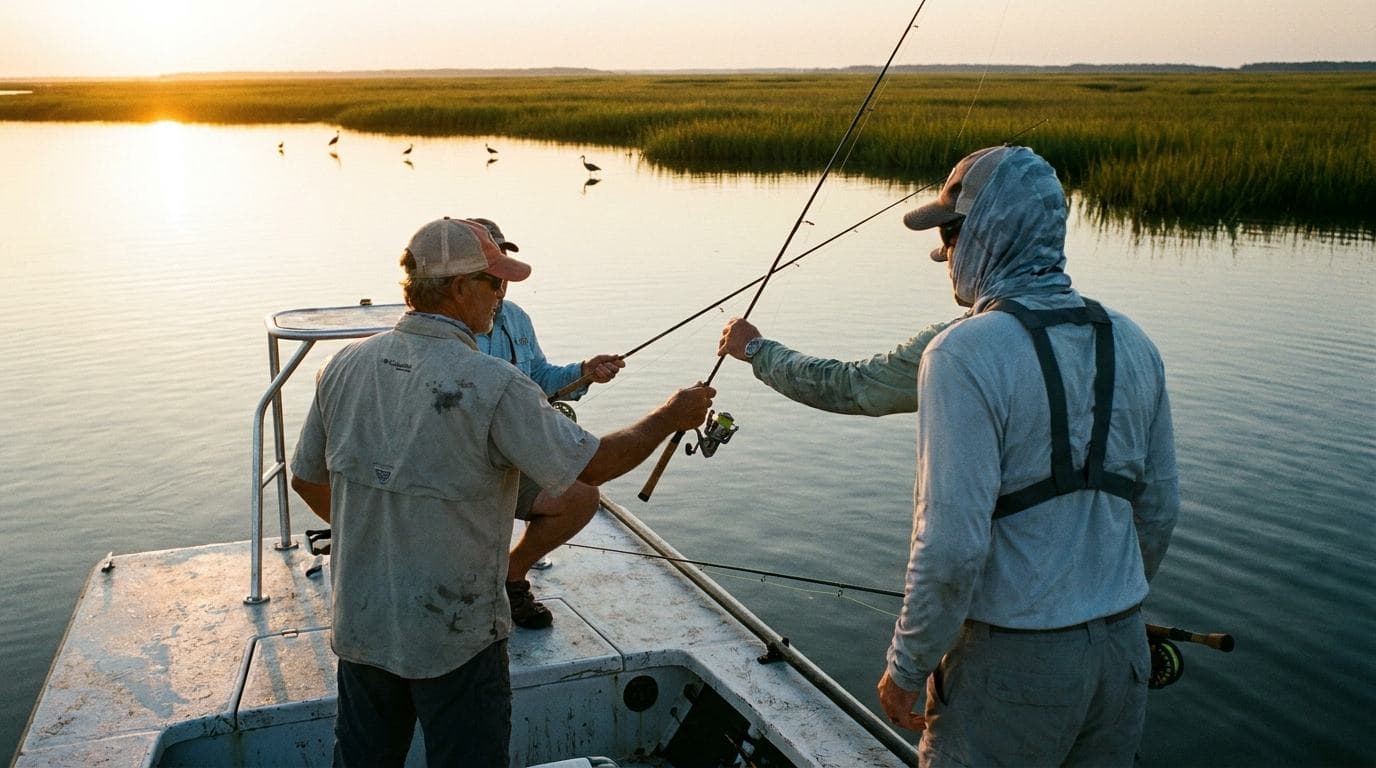
The standard for tipping a fishing guide or charter captain is 15 to 20 percent of the trip cost. That holds from Florida to Alaska, inshore to offshore, spin to fly. The variation comes not from where you're fishing but from who's on the boat and what they actually do.
Inshore Guide, Offshore Captain, Fly Fishing Guide: What's Different
Inshore Guides
Inshore guides — bay, flats, backcountry — typically work solo. It's the two of you, and the guide handles everything: running the boat, poling the flat, reading the water, rigging rods, and coaching your cast all day. A full-day inshore trip runs $400 to $600 in most markets; 15 to 20 percent lands you at $60 to $120. Half-day trips ($300 to $400) call for $45 to $80.
What most clients don't see: fuel, insurance, gear maintenance, and dead months during slow seasons eat most of that charter fee. Tip the full range.
Offshore Charters: Captain and Mate
Offshore trips involve two people receiving the tip, and the split is not equal — because the work is not equal. The captain navigates, reads the water, and runs the boat. The mate rigs every rod, baits every hook, coaches clients on fighting technique, gaffs the fish, resets all the gear between catches, and cleans the catch at the dock. That is continuous physical labor from the time the lines go in until the boat is cleaned up.
On most offshore charters, the mate works entirely on tips. The captain's compensation is built into the charter fee. A $1,000 offshore trip warrants $150 to $200 in tips. Common practice: hand the full amount to the mate, who splits with the captain in whatever arrangement they have. You can also tip them separately, giving the mate the larger share. What doesn't work well is handing the captain the full amount and assuming it gets divided — ask beforehand how the boat handles tips if you want to be sure.
Fly Fishing Guides
Drift boat and wade guides combine instruction with catching. They're managing the oars, reading the river, tying flies, coaching presentations, and netting fish that took 30 casts to fool. Same math: 15 to 20 percent. Full-day float trips ($500 to $700) call for $75 to $140. Half-day trips ($250 to $350) call for $40 to $70.
If you're booking a multi-day lodge or river camp, ask how they handle tipping before you arrive. Many lodges pool tips and distribute across all staff — guides, cooks, and shuttle drivers included. The convention at lodges is 7 to 12 percent of the total package cost, not individual day rates. Tipping guides separately on top of a lodge pool creates awkward situations. Ask when you book.
Why a Slow Day Does Not Change the Math
This is the point most first-timers get wrong.
A guide can read the tide correctly, put you on the right flat, find actively feeding fish, and the bite still doesn't happen. Barometric pressure shifts overnight. Water temperature drops three degrees. Fish move off structure. These things happen to the best captains on the best water. The guide didn't fail to produce fish — the fish failed to cooperate.
What you're tipping for is the guide's knowledge, their preparation, their effort, and their attitude through a long day when nothing's working. A guide who stays upbeat, keeps adjusting, and works hard on a tough day has earned a full tip. Reducing the amount because the redfish weren't there punishes someone for conditions they didn't control.
What does warrant a lower tip: the guide showing up late or unprepared, a bad attitude sustained through the trip, or clear lack of effort when conditions were fishable. In those cases, 10 percent is a fair signal. Even then, speak directly with the outfitter or charter company about what happened — a silent low tip leaves no feedback anyone can act on.
Going the other direction: increase your tip beyond 20 percent when the guide put in real extra effort on a hard day, gave you sustained coaching throughout, or went above and beyond to make the trip work. This happens often enough to be worth recognizing when it does.
Shared and Walk-On Charters
On a shared charter, you're splitting the boat with strangers. The percentage is the same — 15 to 20 percent of your individual share — but work out the logistics before you're standing on a wet dock at noon with people you don't know, everyone tired and ready to leave.
The practical approach: decide before you board what you're going to tip. If five anglers each paid $150 for a half-day shared trip, 20 percent of $150 is $30 per person — $150 combined for the crew. Agree on the range beforehand, bring the cash counted out, and tip as a group at the dock.
Cash or Digital?
Cash is preferred, and the reason is direct: it reaches the guide immediately with no processing fee taken out. A 3 percent card fee on a $150 tip is $4.50 — not catastrophic, but real money to someone who works on tips all season. Bring cash, keep it in a separate pocket, and you won't fumble at the dock.
Venmo and Zelle are increasingly accepted, especially by solo inshore guides who run their own operations. Confirm the method before the trip when you're verifying your booking details — not when you're stepping off the boat. Some captains are set up for digital; some aren't.
Multi-Day Trips
Tip at the end of each day rather than holding everything for the final morning. Daily tips eliminate any end-of-trip awkwardness about whether the cumulative amount was right. Apply 15 to 20 percent to each day's rate separately. On a three-day trip at $600 per day, that's $90 to $120 per day — not one lump sum at the end that's easy to miscalculate when you're tired.
When and How to Hand It Over
Tip at the dock after the boat is secured and the catch is taken care of — not mid-trip, not at the ramp. A clean handoff with a few words about something specific the guide did well goes further than the money alone. "That poling run into the wind was impressive" lands differently than a generic "great trip." Guides remember specific clients.
If you had a good enough day to want to come back, say so and ask directly about availability. The combination of a fair tip and a clear rebooking signal is the best possible ending to a trip from a guide's perspective.
Looking for a guide worth tipping well? Start with how they handle the booking conversation — clear pricing, straight answers, and a written cancellation policy usually predict a captain who earns the full 20%. Browse the rest of the guides library for more trip-planning homework. If you're planning a guided hunt rather than a fishing trip, see our guide to hunting guide tipping etiquette.