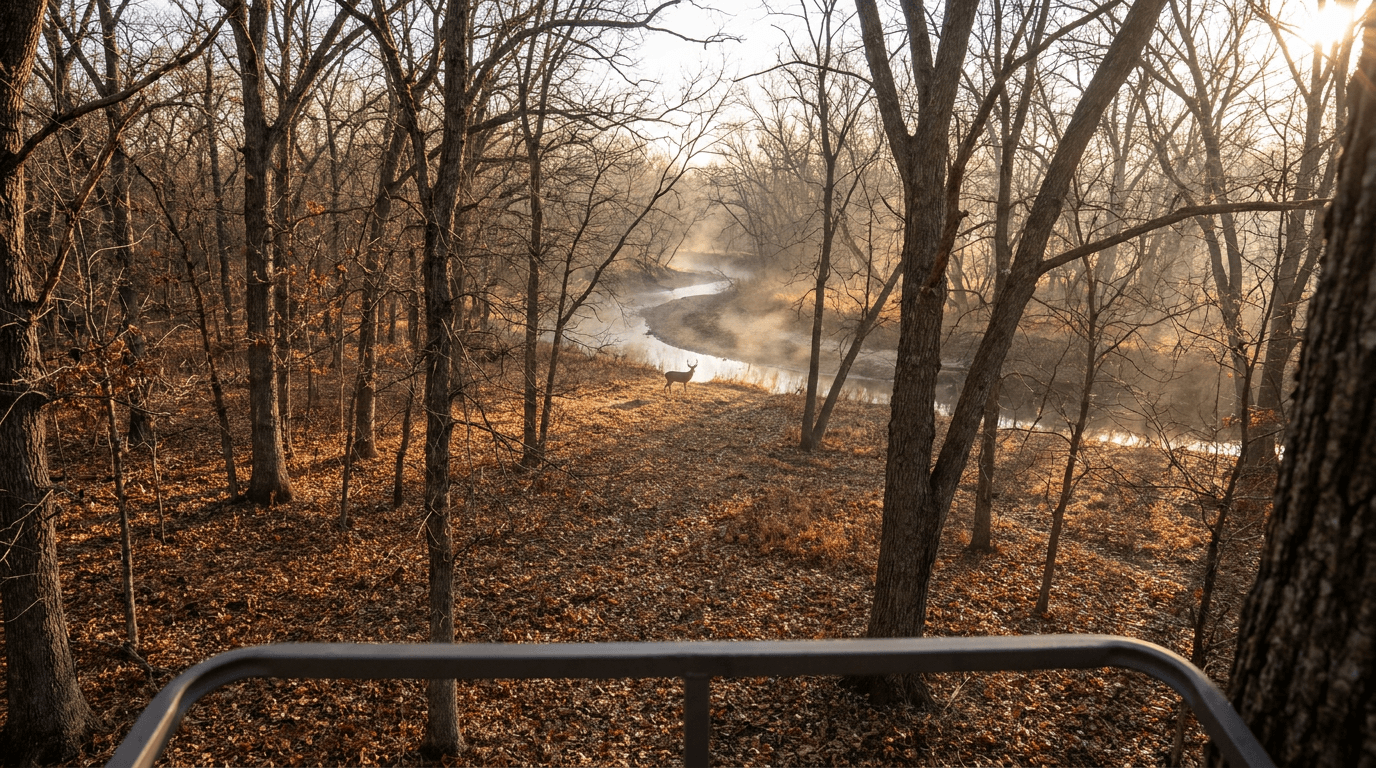
Kansas releases its leftover nonresident whitetail tags every July 1, first-come, first-served, straight through ksoutdoors.gov. If you're reading this in-season and missed the spring draw, that's your move — call around before you assume the year is a bust.
Kansas has quietly become one of the best public-access whitetail states in the country. Not the best-kept secret anymore, either — outfitters in the northeast and southeast units have been booking out a year in advance for a reason. Here's what the season actually costs, how the tag system works, and what a guided hunt looks like once you're in a stand.
Season dates for 2026
Archery season runs September 14 through December 31, 2026. Firearm season is a tight window — December 2 through 13, 2026, the twelve days starting the first Wednesday after Thanksgiving. Kansas also runs an early muzzleloader season ahead of the general firearm opener; check the current dates on the Kansas Department of Wildlife and Parks site before you plan travel, since muzzleloader windows shift year to year more than archery and firearm do.
The rut window that draws most out-of-state hunters — mid-to-late November — falls entirely inside archery season. That's not an accident. Guides who run November hunts are selling rut activity, not just tag availability.
Getting a tag: draw, points, and the July leftover sale
Kansas whitetail permits for nonresidents are draw-only. You apply during a short spring window — April 1 through 24 for the 2026 season — and results come back a few weeks later. Miss that window and the draw is closed to you until next spring, with one exception: leftover tags.
Here's the part a lot of first-timers don't know. After the draw fills, KDWP dumps unclaimed nonresident either-sex whitetail permits back into a first-come, first-served sale, historically opening July 1. If you're planning a fall hunt and haven't applied, this is worth a phone call to KDWP or a check of ksoutdoors.gov before you write off the season.
Draw odds themselves are generous by Western big-game standards. Hunters with one or more preference points draw at close to 100% in most units, and even zero-point applicants clear 90% in several. Units 8, 9, 10, 11, and 14 carry some of the densest whitetail populations in the state — Unit 11 alone allocates over 3,500 nonresident tags, which makes it the most accessible unit for someone applying cold. None of that guarantees a mature buck. It just means getting a tag isn't the hard part in Kansas. Finding good ground is.
What it actually costs
Budget for two separate expenses: the state paperwork, and the hunt itself.
| Item | Cost | Notes |
|---|---|---|
| Nonresident hunting license | $125 + $25 application fee | Required before you can apply for or hold any permit |
| Nonresident whitetail permit | $477.50 | Includes a $27.50 nonrefundable application fee; draw-only |
| State total | ~$627.50 | Before any agent or processing fees |
| Semi-guided/DIY-lease hunt | $2,500–$3,500 | 5–6 days, lodging and meals often included, less hands-on scouting |
| Fully outfitted rut hunt | $5,000–$8,000+ | Prime November dates, managed ground, higher-end lodging |
That's a wide range, and the variable isn't marketing — it's the ground. An outfitter running 2,000 leased acres with year-round trail cameras and a track record of 150-plus-inch bucks charges accordingly. A semi-guided operation that drops you on a stand and checks in twice a day charges a lot less, and for a hunter who mainly wants time in the woods and a fair shot at a deer, that's not a downgrade — it's a different trip.
Ask what "guided" means before you book. Some outfitters mean a guide walks you to a stand and picks you up. Others mean daily scouting, stand rotation based on wind and camera data, and a guide who'll tell you to pass a deer. The $3,000 gap in price is usually that gap in service.
Choosing a unit and an outfitter
Northeast Kansas — the river-bottom country around units 10 and 11 — gets most of the outfitter attention and most of the trophy photos. It's also the most competitive to book and the priciest. Southeast Kansas units run cheaper and less crowded, with solid deer density but a slightly lower ceiling on antler size, according to outfitters who work both regions.
A few questions worth asking before you send a deposit:
- How many hunters share the lease during your week, and how many stands are in rotation?
- Is the outfitter licensed and insured, and can they name their state guide registration if one is required?
- What's the cancellation and weather policy — do you get a rain check, a partial refund, or nothing?
- What's included versus billed separately — meat processing, taxidermy shipping, license help, airport pickup?
- Can they show you recent trail camera footage from the actual ground you'll hunt, not a highlight reel from three seasons ago?
A guide who answers all five without hedging is usually running a real operation. One who gets vague on the lease size or dodges the cancellation question is worth a second call to someone else.
What to expect once you're there
Most outfitted Kansas whitetail hunts run five to seven days and put you in a stand or ground blind before first light and after last light — the classic all-day sit during the rut, shorter sits earlier in archery season. Expect a midday break back at the lodge, home-cooked meals more often than not, and a guide who's checked wind direction and recent camera pulls before deciding where you sit that morning.
Bring layers. Kansas in November swings 30 degrees between a 6 a.m. stand and a 2 p.m. lunch. Scent control matters more here than in thick timber country — a lot of Kansas hunting is edge cover and river bottoms where deer pattern wind hard.
Field-dressing and processing arrangements vary by outfitter. Some include a processor relationship and handle the drop-off; others leave it to you. Confirm this before opening day, not after you've got a deer down forty minutes from the nearest processor.
Before you book
Kansas earns its reputation honestly — genetics, food, and cover that produce mature deer, plus a permit system that, unlike some Western draws, doesn't require a decade of points to get in the door. The tradeoff is booking pressure: the good outfitters in the best units fill a year out, which is exactly why the July leftover-tag window matters if you're planning last-minute.
Whatever unit or outfitter you land on, verify their license and insurance directly and read the cancellation terms before you wire a deposit — a five-minute phone call now beats a bad surprise in November. For more on what to ask any outfitter before booking, our guide to choosing a hunting outfitter walks through the red flags worth watching for, and if tipping etiquette is still an open question, here's what guides actually expect.