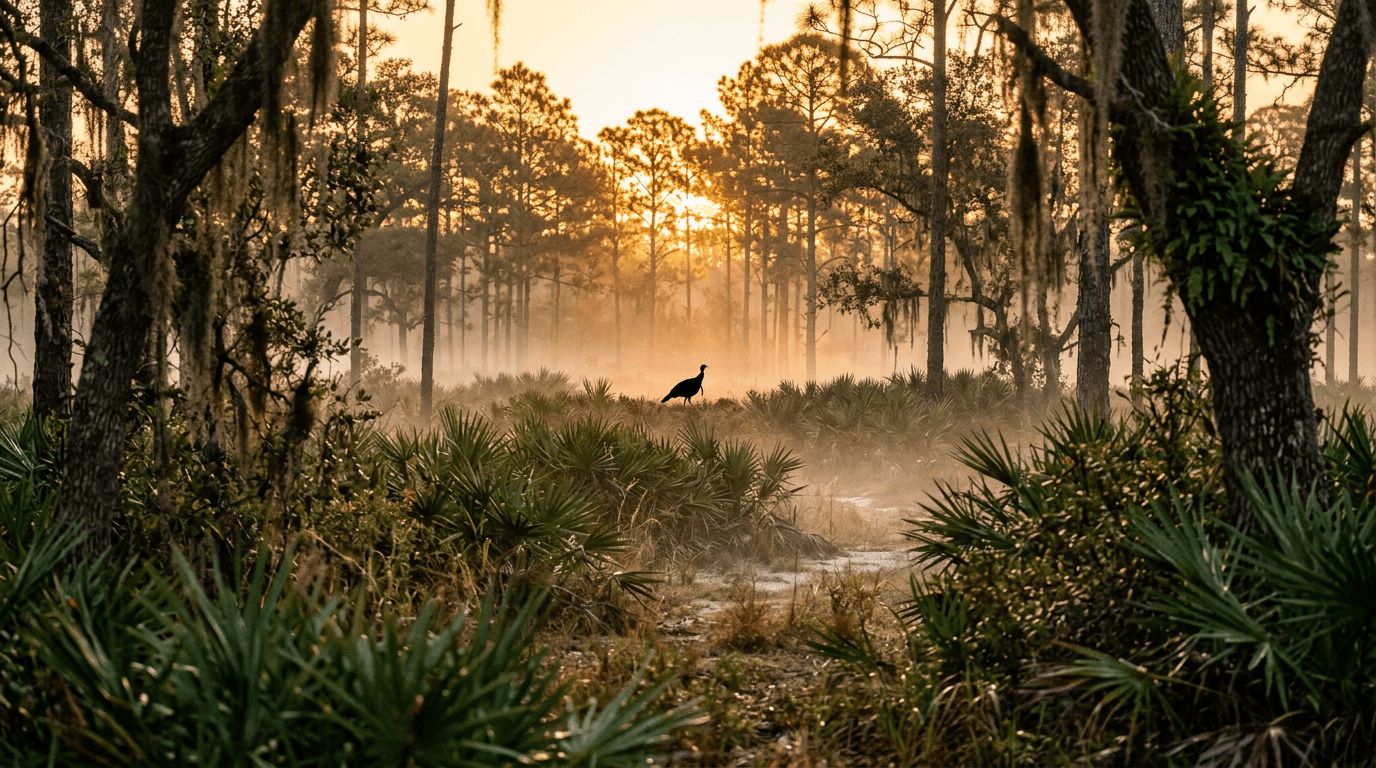
Book a Rio Grande hunt in Texas and a guided day runs $400 to $600. Chase an Eastern on a day-lease in Georgia and you're in similar territory. Then a hunter starts pricing an Osceola in Florida and the first quote back is $2,800. It's not a scam, and it's not Florida outfitters padding their margins because they can. The Osceola is priced like a mini big-game hunt because, economically, that's exactly what it is.
Why This Bird Costs More Than Every Other Turkey You'll Chase
The Osceola only lives south of a line roughly following State Road 70 on the Florida peninsula. Nowhere else. That's the entire range for one of the four birds a Grand Slam hunter needs, and most of that range is private ranch land, citrus groves, and cattle country — not public timber. Public Wildlife Management Areas exist inside the zone, but pressure is heavy and success rates on them are genuinely low. When the bird lives in one small footprint and most of that footprint is fenced, access becomes the product. You're not really paying for three mornings of calling. You're paying for a lease relationship an outfitter has spent years building with a rancher who doesn't return cold calls.
Take a hunter who's already killed an Eastern for $450 and a Rio for $500. He books the Osceola expecting a similar number and gets sticker shock at $2,800. That's not the outfitter overcharging — it's the hunter pricing scarcity like it's abundance. Compare it to booking a flats guide in the Keys during peak tarpon season versus a bass guide on a public reservoir. Same boat, same skillset, wildly different price because one runs on open water and the other runs on a resource everyone's chasing in a tiny window.
What a Guided Osceola Hunt Actually Costs in 2026
Pricing clusters tighter than you'd guess for a hunt with this much variance in outfitter quality. Most 3-day guided hunts on private land run $2,000 to $3,500, and the structure is consistent across outfits: a deposit at booking, the balance due on arrival or before the hunt, and a hard cutoff — you get a set number of mornings and afternoons to close the deal, not an open-ended stay.
| Line item | Typical cost |
|---|---|
| 3-day guided hunt (private land, 3 mornings/3 afternoons) | $2,000–$3,500+ |
| Booking deposit (non-refundable, applied to balance) | ~$1,000 |
| Nonresident annual hunting license | $151.50 |
| Turkey permit (required in addition to the license) | $125 |
| Guide tip (10–15% of hunt cost is the common range) | $200–$525 |
Run the math on a mid-range hunt: a $3,000 package, $1,000 down and $2,000 on arrival, plus $276.50 in state license and permit fees, plus a 12% tip on the hunt cost — $360. That's $3,636.50 before a single night of lodging or a plane ticket, and before you've bought a single shell. It's a real number a hunter can check against any quote an outfitter sends, and it's the number that should be in your head before you call, not the $500 you paid for an Eastern last spring.
When to Book: Zone E Runs Early
Florida splits its spring season at State Road 70, and the Osceola's range falls in the earlier-opening southern zone. For spring 2027, that zone runs March 6 through April 11, with a youth-only weekend February 26–March 1. North of SR 70 opens two weeks later and stays open longer, but that's Eastern territory, not Osceola. If an outfitter quotes you dates that don't fall in early March through mid-April, ask which zone the property sits in before you book — that's the fastest way to catch a mismatch.
Outfitters book their best weeks — typically the second and third weeks of the season, once birds have settled into spring patterns but before pressure builds — a full year out. If you're planning for next spring, the call to make is this month, not February.
Licenses and a 2026 Rule Change Worth Knowing
Nonresidents need a nonresident annual hunting license ($151.50) plus a separate turkey permit ($125) — a 10-day license won't cover you during spring turkey season. That's a change from how Florida used to structure nonresident access, so don't assume last year's paperwork still applies.
There's also a narrower rule worth knowing if you're hoping to hunt public land to save money: starting with the 2026 season, nonresidents can't hunt the first nine days of the zonal spring season on the non-quota units at Big Cypress, Herky Huffman/Bull Creek, Jumper Creek, Three Lakes, or J.W. Corbett. Those are exactly the public WMAs inside Osceola range that budget-minded hunters lean on. It's one more reason the private-land guided hunt isn't really optional for a nonresident on a timeline — it's general orientation, not legal advice, so verify current rules directly with the Florida Fish and Wildlife Conservation Commission before you book anything.
What Three Days in the Palmetto Flats Actually Looks Like
A typical guided Osceola hunt isn't a wilderness trek. It's a lease hunt on working ranch or grove land, run tight:
- Pre-dawn roost checks the evening before, so your guide already knows which oak hammock the birds are using before you ever set a decoy.
- Blind or run-and-gun setups depending on the property — palmetto flatwoods don't offer much natural cover, so many outfitters hunt from ground blinds more than you'd expect from an Eastern hunt.
- A hard stop each morning around 10–11 a.m. when birds go quiet, then a break, then an afternoon sit.
- A set number of hunts — usually six sits across three days — with no guarantee of a bird. Guides are honest about this upfront; anyone promising a kill is telling you what you want to hear, not the truth.
Florida's spring heat and humidity show up fast even in March. Snake boots or tall rubber boots, not the lighter gear that works fine on a cool Kansas morning, are worth the extra weight in the truck.
Tipping Your Guide
Ten to fifteen percent of the hunt cost is the range guides themselves cite most often, with some hunters going to 20% for exceptional effort on a tough property. Tip on the guide's work, not the outcome — a guide who put you on birds for three straight mornings on a tough year earned the same tip whether you connected or not. Ask the outfitter directly what's customary for that specific operation before the hunt starts. Most will tell you straight, and it removes the guesswork on the drive home.
The Advice That Doesn't Apply to This Bird
Every general turkey-hunting article says the same thing: turkey hunting is the affordable entry point into guided hunting, cheaper than deer, cheaper than elk, a good way to try a guided trip without committing real money. That's true for an Eastern in Alabama or a Rio in Texas. It is not true for an Osceola, and treating it like it is costs first-timers real money in mismatched expectations.
The honest version: turkey hunting is affordable when the subspecies is widespread and public land holds birds. Osceola breaks both conditions. One state, mostly private land, a narrow window, and a nonresident license structure that just got tighter. If you're chasing the Grand Slam and budgeting the Osceola leg like your Eastern hunt, add a zero to what you're picturing and you'll be closer to right.
None of that makes it a bad hunt to book — the birds gobble hard, the properties are managed well specifically because access is scarce, and outfitters who've held the same leases for years know their ground cold. It just means walking in with the real number, not the one from a hunt in a state where turkeys are everywhere.
For more on what a guide expects from you once you're booked, see how much to tip a hunting guide and how to choose a hunting outfitter — both worth a read before you send a deposit on any guided hunt, Osceola or otherwise. More trip planning like this lives in the guides library.