Spring turkey season is one of the most accessible entry points into guided hunting. The hunts are typically half-day affairs rather than week-long expeditions, the terrain is usually walkable woodland and field edges rather than backcountry wilderness, and the action — when it happens — is fast and fully audible. A gobbler working toward a call is something you can hear from 400 yards out. Very few other guided hunts give you that kind of advance notice.
If you have never been on a guided turkey hunt, the morning will unfold faster than you expect. Here is what the day actually looks like — what it costs, what you need to handle beforehand, and how the hunt itself unfolds.
What a Guided Spring Turkey Hunt Costs
Turkey is one of the cheaper guided hunts in North America, which is part of why it makes such a good first one. In 2026, a fully guided day hunt commonly runs $400 to $800 per hunter, and two- to three-day packages with lodging and meals typically land between $1,200 and $2,000. Where you fall in those ranges depends on the state, whether lodging is included, and whether you're on private ground the outfitter leases or public land they know well. Treat the ranges as planning numbers, not quotes — every operation prices its own ground.
Deposits work the way they do across guided hunting: expect to put down a third to half of the hunt price to lock your dates, with the balance due at camp or shortly before. Spring dates are a short, fixed window — good outfitters book their best weeks months out, and the deposit is what holds yours.
Here's a full trip, assembled. Take a hunter booking a two-day guided hunt at $1,400 with lodging included:
- Hunt package: $1,400, with a 50% deposit of $700 booking the dates
- Nonresident license and turkey tag: budget around $180 — this varies widely by state, from under $100 to well over $300, so confirm the real number when you book
- Tip for two days of guiding: about $150
That's roughly $1,730 all-in — call it a little over $1,700 — before travel and whatever the taxidermist charges if you want the fan and beard mounted. A one-day hunt at $500 with the same license and a $75 tip runs about $755, which is the number to keep in mind when someone tells you guided turkey hunting is expensive. It's a fraction of what an elk or bear week costs, for a hunt that's arguably more interactive than either.
One thing to be wary of while you're shopping: any outfit selling "guaranteed birds." Spring gobblers are henned-up, weather-moody, and pressure-shy — a guide who's honest about that will talk about encounter rates and how their ground hunts, not guarantees. The guarantee pitch usually means either the fine print redefines "opportunity," or the hunting is the kind of thing you wouldn't recognize as turkey hunting. Ask instead what percentage of hunters had a bird inside 50 yards last season. That's a question a real turkey outfit can answer and a billboard can't.
Before You Go: What You Need to Handle
Your license and tag
You are responsible for purchasing your own hunting license and turkey tag before the hunt. Your guide holds a commercial guide permit; that does not cover your tag. State requirements vary significantly — some states sell spring turkey tags over the counter, others run a draw system with applications due months before the season opens. Confirm the specifics with your guide when you book. They can tell you exactly what to purchase for their state, but buying it is on you.
If this is your first hunting license in that state, check whether a hunter education certificate is required. Most states require one for first-time hunters, and a card from your home state typically satisfies the requirement elsewhere. Ask your guide when you book — it is a routine question they handle regularly.
Your firearm
Most guided spring turkey hunts involve a shotgun — a 12 or 20 gauge with a turkey choke (full or extra-full). You are aiming at the head and neck of a bird at 20 to 40 yards, not the body mass. Turkey-specific loads in No. 4, 5, or 6 shot are standard; bismuth and TSS alternatives work well in smaller shot sizes for tighter patterns. A few operations also accommodate bow or crossbow hunters for clients who want the added challenge.
If you do not own a suitable shotgun, ask your guide before the trip whether they can arrange a loaner — some operations accommodate first-timers on this. If you are traveling across state lines with a firearm, confirm the applicable transport rules before you leave home.
What to wear
Full camouflage from head to foot. That means a camo pattern on your jacket, pants, gloves, and a face mask or face paint covering exposed skin. Turkeys have exceptional color vision — significantly better than deer — and will pick up the pale oval of an uncovered face from surprising distances. Exposed skin gets you spotted before the bird ever closes to shooting range.
Spring mornings are cold. Temperatures before sunrise in April and May drop well below 40 degrees in many states, even when afternoons are mild. Layer: a moisture-wicking base layer, an insulating mid-layer, and a quiet outer shell in a matching camo pattern. Avoid nylon and synthetic fabrics that swish when you move — soft fleece or wool outer layers are substantially quieter and worth the extra weight in the pack.
Wear comfortable, waterproof boots. You may walk through dew-soaked fields or creek bottoms in full dark. Comfort matters because you will be sitting completely still — sometimes for two or three hours — and cold, wet feet accelerate misery faster than almost anything else in the field.
One item most first-timers overlook: a small foam seat pad or cushion. Sitting on cold, hard ground for two hours while remaining motionless is genuinely uncomfortable without one, and shifting to adjust position is exactly the kind of movement most likely to blow a setup that was going well.
The Morning Timeline
Before sunrise: the walk-in
Your guide will give you a meeting time — typically 45 minutes to an hour before first legal shooting light. This gives you time to arrive, review the plan for the morning, and walk quietly to the setup location before turkeys fly down from the roost. Getting into position before legal shooting light is standard; arriving late and bumping birds off the roost is one of the most common ways a morning hunt ends before it starts.
Walk quietly on the way in. No headlamps aimed toward the tree line. No talking above a whisper. The guide will set a pace — match it. If there is terrain to navigate in the dark — a creek crossing, a fence line, brushy ground cover — follow the guide's exact line through it.
Setting up: blind, decoys, position
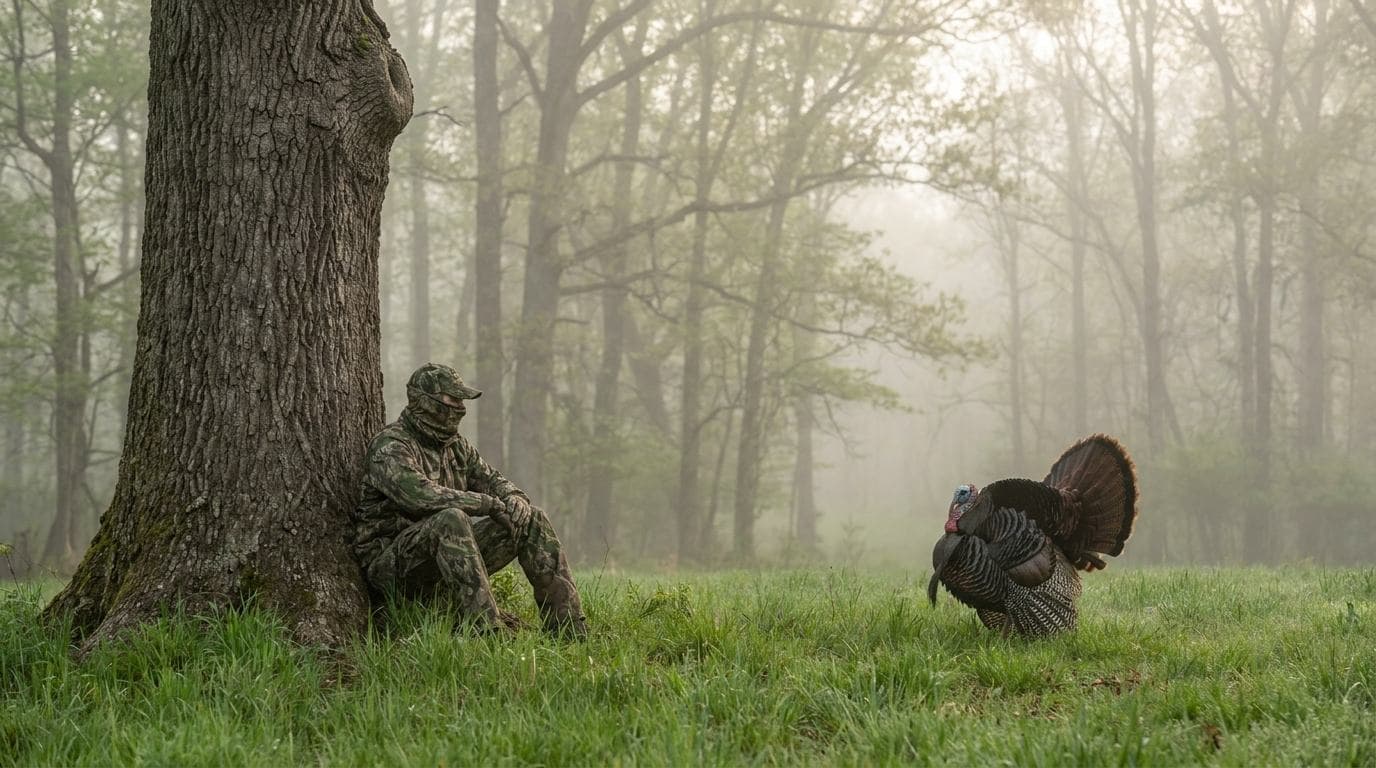
Once in position, your guide will place any decoys — typically a hen, or a hen and jake combination set 15 to 20 yards in front of your setup. You will be positioned behind the decoys, either inside a portable ground blind or seated against the base of a large tree with your back and sides covered. A ground blind allows slightly more movement; sitting against a tree requires you to stay completely still once birds are in close.
Get settled and arranged before it is fully light. Position your shotgun so it points naturally in the direction birds are most likely to approach. Place your seat pad. Put your gloves and face mask on before shooting light arrives. Once you hear the first gobble from the roost, the time for adjusting any gear is over.
First light: fly-down time
At first light, your guide will make soft tree yelps — quiet calls that mimic a hen waking on the roost. When a tom answers from the trees, every instinct will tell you to move, turn, or react. Do not. Stay still.
Turkeys fly down anywhere from 15 minutes before official sunrise to 30 minutes after, depending on weather, hunting pressure, and how the morning feels to the birds. The moments immediately after fly-down are often the most productive window of the day. A tom that pitched down on his own schedule may come directly to the decoys in under 10 minutes. Or he may follow a group of real hens in the opposite direction and leave you waiting. Both happen regularly. Neither is a reason to move.
The sit: patience is the job
After fly-down, your role is to sit still and let the guide call. Do not whisper commentary about what you are seeing. Do not shift to get comfortable. Do not check your phone. The guide is reading the bird's behavior in real time — adjusting call sequences, going quiet when a tom is already moving and additional calling would make him suspicious, switching between calls if one approach is not producing. They need silence to work effectively.
Commit to the setup for at least an hour before the guide decides to relocate. Moving too early is one of the most consistent first-timer mistakes. A tom that appeared hung up at 200 yards and went quiet might be standing at 80 yards, working himself up to commit — and you will never know if you have already started packing up to move.
When a bird comes to the decoys, your guide will tell you quietly when to raise the gun and when you can shoot. Confirm you can see the bird's head and neck clearly — not just color or movement in brush — before you touch the trigger. Shoot when the guide says shoot.
If the Morning Goes Quiet
Not every turkey hunt ends by 9 AM. If the morning roost birds dispersed without committing, productive hunting often continues from mid-morning through early afternoon. After hens leave toms to return to their nests — typically between 9 and 11 AM — gobblers become more lonely and more responsive to calls. A midday setup in a known strutting zone, field edge, or travel corridor can produce birds that would not have moved during the early hours. Ask your guide whether this is part of the plan, especially if you have the full day available.
Safety: The One Rule That Does Not Bend
Never wear red, white, blue, or black in turkey woods — these colors appear on a gobbler's head and have caused hunting accidents when other hunters mistake a moving hunter for a bird. Full camouflage from head to foot is both more effective and significantly safer. Positively identify the bird — species and sex — before you raise the gun. Never shoot at sound or movement alone. Your guide will reinforce all of this; follow their lead on anything safety-related without question or hesitation.
After the Hunt: Tipping and Field Care
If your guide put you on birds and the experience delivered, a tip of $50 to $100 per hunter is customary for a half-day spring turkey hunt. If the hunt required significant additional effort — difficult terrain, a long drive to reach the property, multiple relocated setups across a full day — the upper end of that range or above is appropriate. Tip in cash at the end of the hunt.
If a bird was harvested, confirm with your guide before the hunt what happens next. Some operations have processors they work with or will help with field care on the property; others expect you to handle it yourself. Know this in advance so there is no confusion in the field.
Why Turkey Hunting Gets Under Your Skin
Most guided hunting puts you in a stand or blind where the guide's scouting has already done the heavy work, and your job is patient waiting. Turkey hunting is more interactive than that. You hear the bird long before you see him. You watch the guide make real-time decisions based on how the tom is responding — calling more, going silent, switching from a box call to a slate. When a gobbler breaks strut and starts walking in with his fan spread and his head up, the experience is hard to describe to someone who has not been there. That interactive quality — the back-and-forth between guide and bird — is why turkey hunting produces as many committed return clients as nearly any other guided hunt type.
When you are ready to find the right guide, read how to choose a hunting outfitter — including what to verify about licensing and experience before you book. For a look at what tipping your guide typically looks like across hunt types, see hunting guide tipping ranges and etiquette.