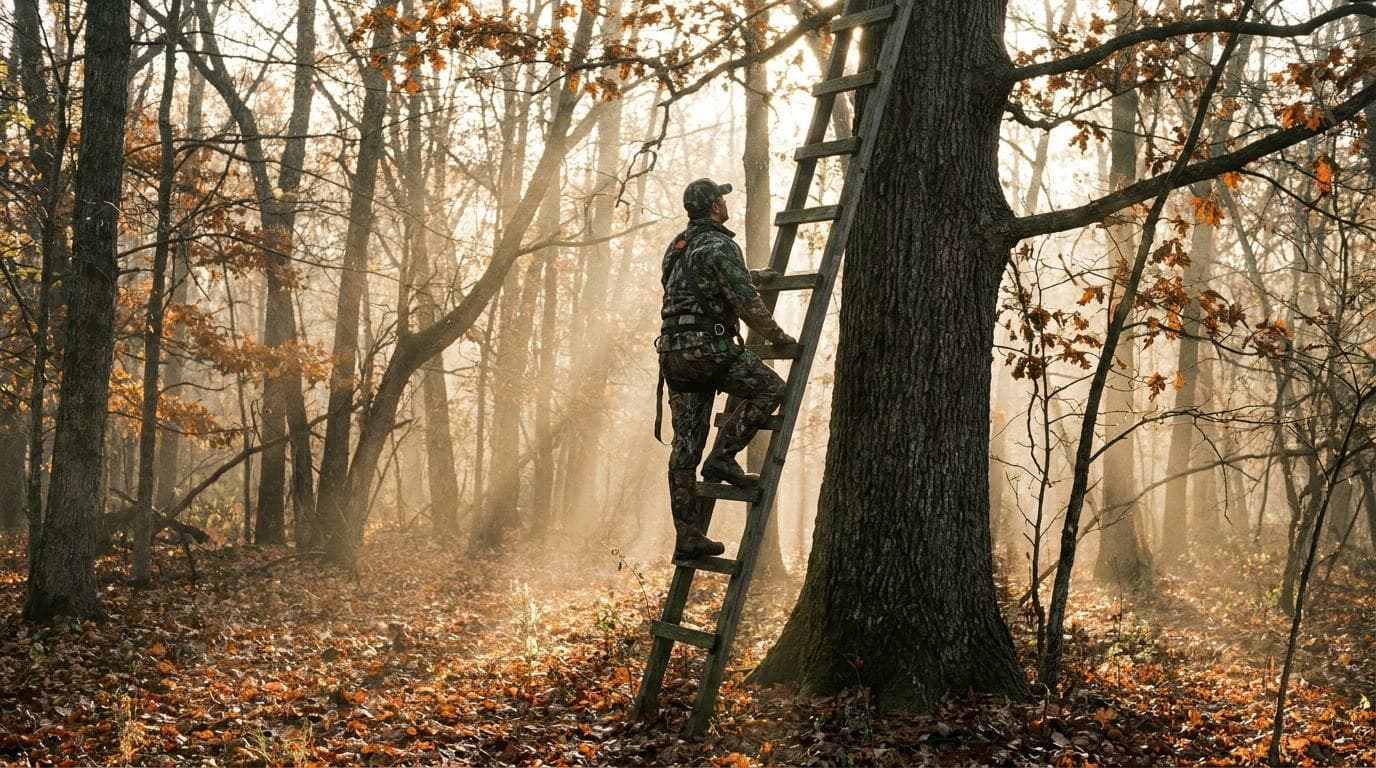
Most first-timers go into a guided whitetail hunt with two concerns: shooting a deer and not embarrassing themselves in front of the guide. The actual experience involves considerably more logistics than either of those, and outfitters vary widely in how much they explain upfront.
What follows is the full arc — from the booking call through the final morning sit — so you arrive knowing what's normal and can spend your energy on the hunt rather than the uncertainty.
What you're actually buying when you hire an outfitter
A guided whitetail hunt packages three things: access to private land that's managed for deer, months of scouting and stand preparation done before your arrival, and a guide who knows the specific animals on that specific property. You're paying for their accumulated knowledge of that herd's movement patterns — not just permission to stand in the woods.
Most guided hunts include lodging, meals, guiding services, and access to the property. Processing is sometimes included and sometimes billed separately — ask before you put down a deposit. Taxidermy is almost never in the base price, and outfitter referrals to taxidermists vary in quality, so do a little homework in advance if you plan to mount your animal.
Prices range considerably by region and season. Midwestern free-range whitetail hunts typically run $2,500 to $6,000 for a 4- to 6-day package. Texas and Southeast properties can be lower for management-class deer or doe hunts and higher for proven trophy ground. Deposits run 25 to 50% of the total, and most are non-refundable.
The booking process
A serious outfitter will spend real time on the phone with you before accepting a deposit. They need to know what you're after — a mature buck, a first deer, a management harvest — because that affects which stands they put you in and how they guide the shot. They should ask about your shooting experience and your physical condition, particularly if the property involves tree stand climbs or significant walking in the dark before dawn.
Things to confirm before you pay:
- What is the cancellation and weather policy?
- What is the minimum age or antler size you're allowed to harvest? Some managed properties pass on any deer under three and a half years old.
- What license and tags do you need, and who buys them? In most states, that's your responsibility. The outfitter will tell you exactly what's required for their state; purchasing it is on you.
- Is this a high-fence or free-range operation?
- How are the morning and evening sits structured — do you hunt both, or only one per day?
What the outfitter is doing before you arrive
By the time you pull into camp, a well-run outfitter has been preparing for your hunt for months. Game cameras have been running on feeding areas, travel corridors, and active scrape lines. Stands have been set or repositioned based on prevailing wind patterns for your specific hunt dates. If they manage food plots — clover, brassicas, or corn — those were planted in summer.
The guide who takes you out in the morning knows individual deer on that property by sight. They'll assign your stand based on the morning's wind direction, often decided the night before or early that morning. The placement isn't improvised — it's the product of weeks of camera pulls and glassing from field edges.
This is the core of what you're paying for. A good outfitter isn't guessing which stand to use on a cold November morning. They've already worked it out.
What to bring, and what they provide
Outfitters generally provide stands, blinds, and access to the property. They do not provide your firearm or bow, your ammunition, your hunting clothes, or your license and tags.
For a November whitetail hunt in the Midwest, temperatures before dawn can be well below 20 degrees Fahrenheit. You will sit still for two to four hours at a stretch. Layering is not optional, and the outer layer matters more than most first-timers realize — synthetic fabrics that swish when you raise your rifle or draw a bow have cost hunters deer. Quiet, scent-controlled outer layers are worth the investment before your first trip, not after it.
A working packing list for a 5-day whitetail hunt:
- Moisture-wicking base layers, two or three sets
- Fleece or wool midlayer
- Quiet outer hunting layer, scent-controlled, rated for the expected temperatures
- Insulated hunting boots rated to at least -20 degrees Fahrenheit for Midwest and Northern hunts
- Wool or fleece socks, multiple pairs
- Blaze orange if required in your state — check your state's regulations, not just the outfitter's state
- Balaclava or neck gaiter and warm gloves
- Headlamp with a red-light setting for the pre-dawn walk to stand
- Snacks for the stand — quiet packaging only, no crinkle wrappers
- Your grunt call and rattling bag, unless the outfitter provides them and prefers you use theirs
The daily schedule
Most outfitters run two sits each day: morning and evening. A typical day looks like this.
Wake-up is before dawn — often 4:30 or 5 AM. A quick breakfast at the lodge, then you dress and depart. Most guides drive hunters to a drop point and walk in the dark to the stand. You're in position before first legal shooting light.
The hunt is quiet time. Your guide leaves you alone — that's intentional, not neglect. On properties with cell service, guides sometimes check in by text at midmorning. On others, they return in person at a pre-agreed time. A four-hour morning sit without seeing a deer is entirely normal and is not a sign that anything has gone wrong.
Midday is lodge time: lunch, rest, and often a review of the morning camera pulls. Deer movement typically slows from mid-morning through early afternoon, so hunting this window usually isn't worth the disturbance to the stand. The evening sit starts around 2:30 or 3 PM and runs until legal light ends. Activity often concentrates in the final 45 minutes before dark.
High-fence versus free-range
High-fence operations contain deer within large enclosed properties — sometimes several thousand acres — where herd composition and genetics are actively managed. Free-range operations have no perimeter barrier; deer move in and out of the property naturally.
Neither is categorically better. High-fence hunts often provide more certainty of encountering mature, trophy-class bucks and can be structured to allow selective harvest by age class. Free-range hunts involve animals behaving naturally, with success depending more on weather, rut timing, and hunting pressure across the surrounding landscape.
If your primary goal is filling a tag on this specific hunt, either can deliver that. If the wild and unpredictable nature of the experience matters to you, know which type you're booking before you pay a deposit. The distinction isn't always clearly advertised.
When you harvest — and when you don't
When you take a shot, contact your guide immediately. Describe the shot precisely — where you aimed, where you think it hit, how the animal reacted, and where it went. Then wait. Resist walking to where the deer was standing without the guide present. A deer bumped from its bed after a marginal hit is one of the more preventable bad outcomes on a guided hunt.
Once the animal is recovered, the guide handles field dressing and getting it out of the woods. Processing arrangements vary by outfitter: some process on-site, some have a nearby processor they use regularly, some hand the field-dressed animal back to you. Confirm this arrangement before the hunt starts.
If the season closes and you haven't harvested, that's hunting. A reputable outfitter won't guarantee a kill — and any who does should raise your suspicion. What they can guarantee is access, preparation, and time on ground that holds deer. The animal makes its own decisions.
Tipping your guide
Tipping a hunting guide is standard practice, but how you compute it should depend on the kind of hunt. On a single guided day, flat dollars are the working norm: $50 to $150 per hunter, scaled to how hard the guide worked. On a multi-day lodge package like this one, a straight percentage starts to overshoot, because the package price folds in things your guide never touches — lodging, meals, and the land lease that may be the biggest line in the outfitter's budget. You're tipping the guide's labor, not the outfitter's lease payment. That's why the on-the-ground norm for a 3-to-5-day lodge whitetail hunt is a flat $200 to $400 per hunter, while the 10-to-15-percent convention you'll see quoted really belongs to wilderness elk and big-game hunts, where the guide is packing, glassing, and butchering across every one of those dollars. The full tipping breakdown by hunt type covers the ranges in detail.
Worked out on a $4,000 5-day hunt: 10 to 15 percent says $400 to $600; the flat-dollar norm says $200 to $400. Let effort settle it. A guide who repositioned you daily on wind, stayed in contact, and handled a long tracking job earned $400. A drop-you-at-the-ladder operation earned $200. Tip in cash at the end of the hunt, directly to the guide or guides who worked with you.
Camp staff — cooks, wranglers, or a camp manager — are tipped separately if the operation has them. Fifty to a hundred dollars per person for a multi-day hunt is a reasonable range. On that $4,000 hunt, a $300 guide tip plus $75 for the cook puts the whole envelope at $375 — plan for it when you budget the trip, not on the last morning.
Booking again
If the hunt met your expectations, the best time to rebook is before you leave camp. Good outfitters on productive ground fill fast — some are booked a year in advance for peak rut dates in late October and early November. Locking in your dates while you're still there, before they go back up publicly, costs nothing and keeps you off a waitlist.
Planning your first guided whitetail hunt? Browse the rest of the guides library for more on choosing an outfitter, tipping, and what to ask before committing to a deposit — and when you find the right outfitter, book with them directly.