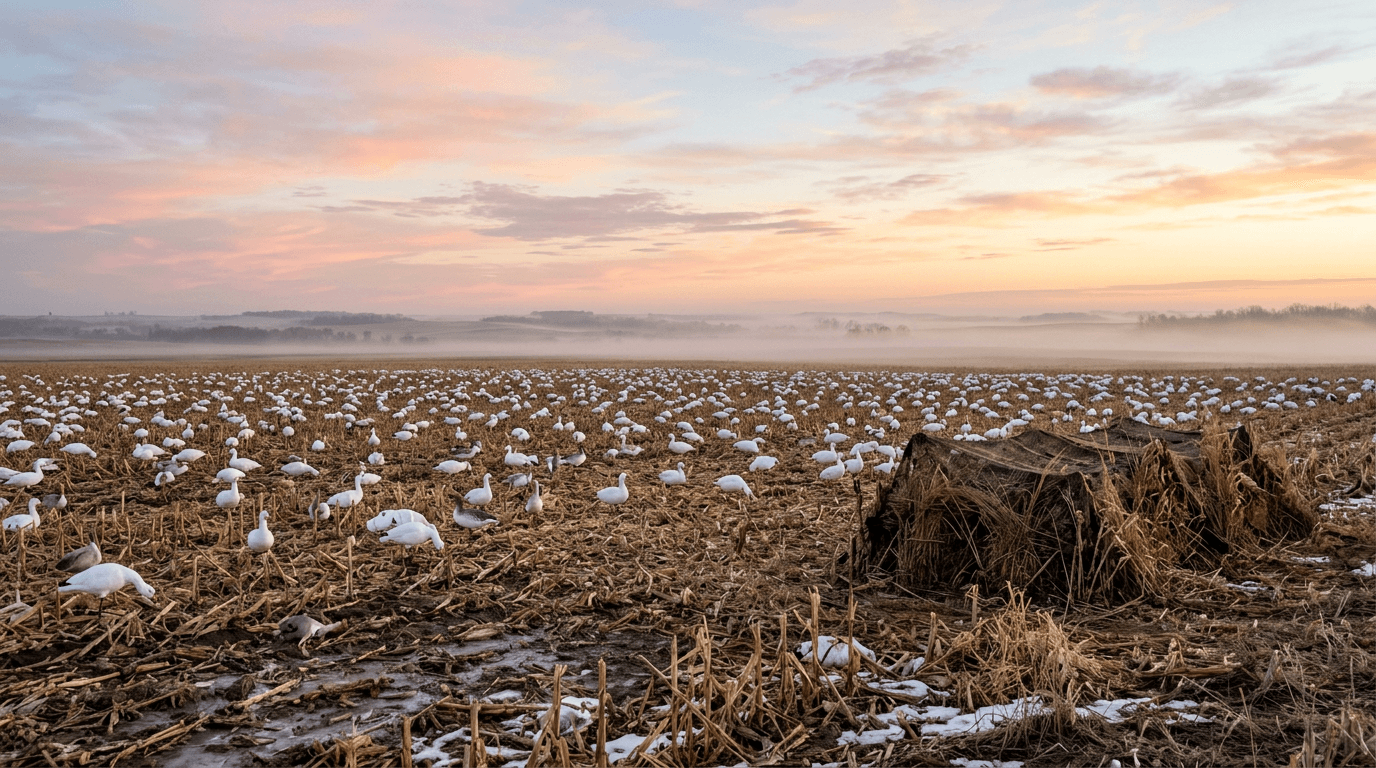
Nebraska's spring snow goose season is the one hunt in North America with no bag limit and no possession limit. Every outfitter page mentions that. Almost none of them mention what it actually does to the math of booking a hunt, or why a "no limit" trip is, day for day, the least predictable guided hunt you can book.
Here's the short version: the no-limit rule is real, and it's genuinely unusual. It is not a promise of big numbers. If you book one day expecting a slaughter because the regulation allows it, you are booking the wrong length of trip.
Why Nebraska Runs a Season With No Limit At All
Light geese — snow, blue-phase, and Ross's — overpopulated so badly through the 1990s and 2000s that their Arctic breeding grounds started collapsing under the grazing pressure. The federal response was the Light Goose Conservation Order: an emergency harvest tool, not a normal hunting season. States that opt in can drop the daily and possession limits entirely and let hunters use electronic calls and unplugged shotguns, both banned in every other waterfowl season in the country.
Nebraska's order opens February 10, with the closing date set by zone — early April in the Rainwater Basin and West Zone, mid-April in the East Zone. Shooting hours run half an hour before sunrise to half an hour after sunset, longer than standard duck-season hours. Check Nebraska Game & Parks directly before you book; conservation-order dates get set fresh each year and outfitter marketing copy is not always current.
What a Guided Hunt Actually Costs
Rates vary by state and by how exclusive the setup is. Here's what outfitter pricing pages across the region were listing this season:
| State | Single-day rate | Multi-day package | Notes |
|---|---|---|---|
| Nebraska | $300/hunter (open field) | Private pit: $1,500–$2,200/day (up to 7 guns) | Volume punch-card rates run $270–$290 per hunt-day |
| Missouri | $225/day, $200 half-day | $650 for a 2.5-day hunt | Plus a $45 state spring snow goose license; 50% deposit |
| South Dakota | $225/day, $200 half-day | $650 for a 2.5-day hunt | Six-hunter minimum to lock a private field |
| Arkansas | $250/day, $225 half-day | $725 for a 2.5-day hunt | 50% deposit at booking |
Confirm current numbers before you wire a deposit. Outfitter rates move year to year and these are what a spread of listings showed for the current season, not a locked-in price you're guaranteed to see.
The Math Nobody Runs Before Booking a Pit
The private-pit option sounds like the upgrade. Sometimes it's just a different way to spend the same money.
Take a Nebraska pit at $2,200 a day, split seven ways: $314.29 a gun. That's within a few dollars of the $300 open-field rate you'd pay solo. The pit isn't cheaper — you're paying almost the same amount for privacy and a bigger spread instead of a discount.
Now split that same pit four ways: $550 a gun. Double the open-field rate, for the same 1,500 floating decoys and no strangers sharing your blind. That's a real premium, and it's worth paying for some groups. It is not a savings play, and any outfitter who frames it that way is doing you the math wrong.
Run the package numbers the same way. Missouri's 2.5-day package runs $650 a hunter. Book three single days instead and you'd pay $675. Twenty-five dollars. That's the entire discount for committing to the multi-day rate — which tells you the package isn't really a bulk discount. It's a length-of-trip decision dressed up as a pricing tier.
Here's the Part the "No Limit" Marketing Skips
This is where most trip-seeker advice gets it backwards. A no-limit season sounds like a guaranteed pile of birds. Spring snow goose hunting is closer to the opposite: it's one of the most weather-dependent, boom-or-bust guided hunts you can book, no-limit rule or not.
Migration reporting from outfitters who track it season over season lands on a rough pattern: across any three-day stretch, expect roughly one day of real shooting — 35 or more birds for the group — and the other two ranging from slow to dead. Birds move on a south wind and vanish on a north one. Sunny and breezy tends to beat calm and gray. A field that was on fire Tuesday can be empty Wednesday because the whole flock pushed 200 miles overnight.
That's precisely why the 2.5-day package outsells the single day almost everywhere it's offered. You're not buying three chances at the same result. You're buying enough days to be there for the one that delivers.
Book a single day on a no-limit hunt and you're gambling on weather. Book three and you're just buying insurance against it.
What an Actual Day Looks Like
Morning hunts typically run from legal shooting light until around 10 a.m., when the birds quit moving. Guides break for the afternoon, then reset for an evening sit starting around 3 or 4 p.m. that runs to sunset — which, by late March, can mean staying in the blind past 7 or 8 p.m. It's a long day split into two sits, not one continuous hunt, and that split exists because geese simply don't fly the hours in between.
Bring layers you can shed. February mornings in the Rainwater Basin sit well below freezing; by an April afternoon you can be down to a base layer in the same blind. Pack for both, because you'll hit both in the same trip.
License, Deposit, and the Questions Worth Asking Before You Book
- License: Nebraska requires a state hunting license plus the appropriate migratory bird permits; non-residents pay more than residents, and requirements can change year to year. Confirm current requirements directly with Nebraska Game & Parks before you travel.
- Deposit: Most outfitters in this space ask for 50% at booking, non-refundable. Ask what happens if a snowstorm or a dead migration wipes out your dates — a credit toward a rebook is common; a refund usually isn't.
- Group minimums: Several outfitters require a minimum headcount (commonly six) to guarantee an exclusive field. Solo hunters and pairs often get placed with other parties instead — ask directly, since it changes both your cost and your experience.
- Length of trip: Given the day-to-day variance above, a single day is the highest-risk way to book this hunt. If your schedule allows it, the 2.5- to 3-day trip is the one that actually matches how these birds behave.
None of this makes spring snow goose hunting a bad trip — it makes it a specific kind of trip, and the outfitters who are straight with you about the odds are usually the ones worth booking with. For more on what separates a guide worth trusting from one that's overselling the brochure, our guide to choosing a hunting outfitter covers the questions to ask before any deposit changes hands. And if you land a good one, our guide to tipping a hunting guide has the ranges guides actually expect after a hard-earned limit day — or a slow one.