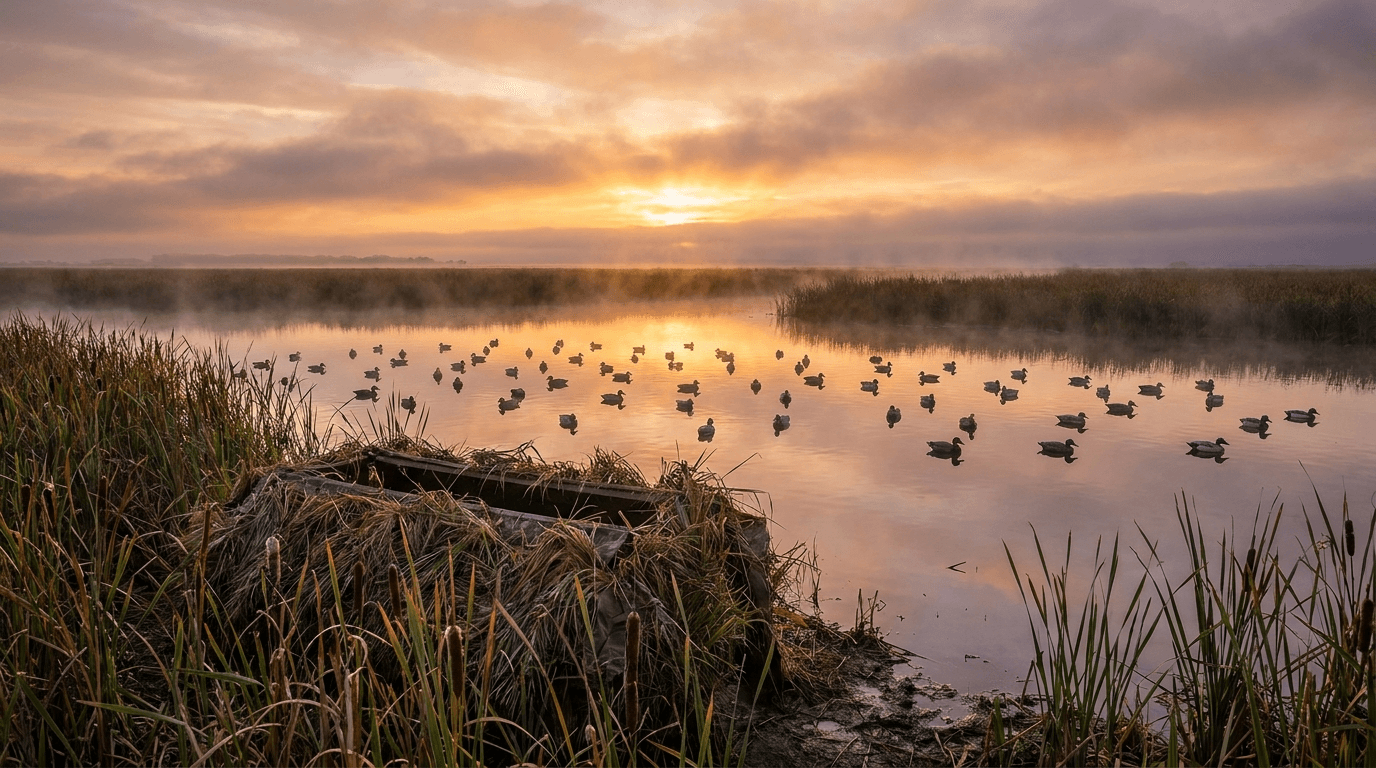
A duck call and a short-reed goose call are different instruments. They sound nothing alike, they sit differently in your hand, and they want completely different air. A lot of beginners treat them as one skill, split their practice down the middle, and end up mediocre at both. That's fixable, and the fix has nothing to do with talent. Calling rewards ugly repetition more than natural ability — nobody sounds good in their first month, and the hunters who sound right by opening weekend are the ones who started short daily reps in the off-season instead of digging the call out of the truck box the night before the first hunt.
Here's the honest version of what a first-year caller needs: three duck sounds, three goose sounds, a feel for when to use each, and a practice habit that survives a work week. That's it. Everything else is refinement.
Three Duck Sounds Cover Most Mornings
Mallards have a deep vocabulary, and it's tempting to chase all of it at once. Don't. Three calls handle the vast majority of situations a new caller will actually face:
- The greeting call. A mid-range run of five to seven notes that tells distant birds "here I am." This is your bread and butter, and it should sound relaxed rather than urgent.
- The feed chuckle. A fast, low "tuk-tuk-tuk-a-tuk" made by chattering your tongue against the reed while you feed steady air. It's for birds already interested and working the spread — not for getting attention in the first place.
- The comeback call. Sharper and more insistent than the greeting. When a flock looks your spread over, hesitates, and starts to peel away, this is the "don't leave" call.
Notice what's missing: the highball. It's the loudest, most dramatic sound a duck call makes, which is exactly why beginners overuse it — it's the most satisfying thing to blow. Save it for birds genuinely too far out to hear anything else. Inside a couple hundred yards, a highball is more likely to flare working birds than pull them.
Goose Calling Is Built on the Cluck
Short-reed goose calls run on different mechanics. Pitch and cadence come as much from your off hand, cupped over the end of the call, as from your air. Three building blocks:
- The cluck. A short, sharp "ga-wick" — tongue anchored behind your bottom front teeth, fast air. This is the foundation. Nearly every other goose sound is a variation on it.
- The double cluck. Two clucks back to back, the second pitched lower, made sharp and close together. Your mid-range call for birds that are working.
- The moan. A low, growling "who-who-who" made deep in the throat while air keeps moving through the call. Geese make this sound on the ground while they feed, which is why it finishes birds so well — it's the sound of geese that already landed and like where they are.
Drill the cluck until it's automatic before you touch the rest. A caller with the cluck locked in builds double clucks, rolling clucks, and moans in a fraction of the time, because the mechanics underneath are the same.
Sequence Beats Vocabulary
Individual sounds matter less than knowing when to use which one, and that's the part beginners skip. For both species, a workable sequence follows the same shape: loud and attention-grabbing at distance, easing off as birds commit, nearly silent once they're locked up and finishing.
With ducks working from several hundred yards, open with a greeting call to turn them toward the spread. As they close and start to look interested, back the volume off — shorter, softer greeting notes mixed with the occasional feed chuckle. If a flock makes a pass and drifts instead of committing, that's the comeback's job: faster, more insistent, telling them not to leave. Once birds are cupped and dropping, go quiet, or hold soft feed chuckles only. A duck that's locked up doesn't need convincing; more calling at that point just hands it a reason to look twice.
Geese follow the same arc with their own call set. Open with louder hail-style honks to turn distant birds. As they commit, shift into a faster, more excited two-note greeting mixed with clucks. Inside real range, the double cluck takes over as the working call, with moans folded in as wings set. The thread running through both species: the closer the bird, the softer and less frequent the calling. Beginners do the opposite — excitement builds, calling hardens — and that's usually the fastest way to put working birds on the fence line instead of in the decoys.
Picking Your First Calls
For ducks, a double reed is the forgiving place to start. It produces a full sound without demanding precise air control, which buys you room to make mistakes while your breath support catches up. Move to a single reed later if you want more range and realism; it rewards clean technique and punishes sloppy air in equal measure.
For geese, a short reed is the standard, and there's no strong reason to start anywhere else. Most of the hunters and guides you'll share a blind with are running short reeds, so learning on one means learning the call you'll actually hunt with. It takes longer to sound decent on a short reed than on a flute-style call — which is exactly why the practice weeks before the season matter more for goose calling than for duck.
Whatever you choose, buy a call you can afford to wear out. A cheap call blown constantly teaches more than an expensive one that stays in its case because you're worried about scratching it.
Reps That Transfer to the Blind
Ten to fifteen minutes a day beats a two-hour Saturday session. Calling is muscle memory — diaphragm, tongue, hand position — and short, frequent reps build it faster than occasional long ones. A few habits worth stealing:
- Drive time is call time. A call in the cupholder gets blown at stoplights and on backroads far more than one living in a gear bag.
- Record yourself. A phone voice memo exposes the flaws you can't hear mid-blow — a cluck that drags, a greeting that breaks pitch. Obvious on playback, invisible in the moment.
- Practice the scenario, not just the sound. Stand in the yard and picture a flock at 300 yards, then 150, then finishing. Run the actual volume and cadence changes.
- Listen to real birds. Resident Canada geese are around all summer in most of the country. Ten minutes near a local flock teaches more about natural cadence than any instructional video.
The Mistakes That Give a Beginner Away
Calling too much is the big one, and it's almost always driven by excitement rather than by reading the birds. If ducks or geese are already committed and working the spread, more calling adds risk without adding pull. Save the loud stuff for birds far enough away to need it.
The second mistake shows up in crowded blinds: everyone calling the same sequence at the same volume. Three or four hunters blowing greeting calls in unison stops sounding like a flock and starts sounding like a chorus. Real birds don't harmonize. One caller runs the sequence while the others stay quiet or back it up softly — that sounds like ducks.
Where a Guided Hunt Fits In
There's a limit to what the driveway can teach, and a good caller's blind is the fastest way past it. A morning next to someone who calls for a living compresses months of solo trial and error: you hear when they call, and — more valuable — when they don't. You watch a flock answer a comeback call in real time, see birds finish to near-silence, and start connecting the sounds to what the birds actually do. Most guides are happy to talk calling between flights, and plenty will let a client run backup once the pressure's off.
If waterfowl is new to you, or you're hunting unfamiliar water this season, that's when a guided hunt earns its cost — the calling education comes free with the birds. Independent waterfowl guides run their books on timberandtackle.guide, and booking direct means the person calling over your decoys keeps the whole trip price.
Either way, start the reps now and keep them short and daily. By the time decoys hit the water, the calling won't be the part of the hunt you're worried about.