Lake Erie doesn't belong to one state. Four of them touch its walleye grounds — Ohio, Michigan, Pennsylvania, and New York — plus Ontario across the international line. That's unusual for a charter fishery, and it changes three things before you book: which license applies, how far you might drive to reach the best water, and why one captain's "best month" won't necessarily match the next marina's over.
Here's the part that surprises first-timers: walleye don't need a closed season to stay healthy. Lake Erie runs one of the best-managed freshwater fisheries in the country, with harvest set by an interstate quota system instead of a hard start-and-stop calendar. You can book a trip almost any month boats are running. Whether you should is a different question, and it depends on what you actually want out of the day.
When Walleye Actually Bite: A Real Season, Not a Closed One
The Ohio Division of Wildlife has tracked catch-per-angler data long enough to say this plainly: July produces the best catch rate of any month in the western basin. That's the headline. The rest of the season has its own logic, and it's worth knowing before you pick a date.
- April through early May — pre- and post-spawn fish stack up shallow near the reefs and river mouths of the western basin. Numbers can be excellent, though weather is the least predictable of the year.
- June — steadier weather, still strong numbers, and generally the most forgiving month to bring a first-timer or a kid along.
- July — the peak, by the state's own catch-rate data. Warmer water pushes fish into a predictable pattern that trolling crews exploit well.
- August through September — the action shifts east into the central basin, where cooler, deeper water holds fish through the hottest stretch of summer. Mornings and evenings outproduce midday.
- October — falling water temperatures push walleye back toward shore for one more push before the season winds down for most charter operations.
None of this is a rule. It's a pattern, and patterns shift with wind, water clarity, and a warm or cold spring. A captain who fishes the lake every week will read that week better than any article can.
What a Walleye Charter Actually Costs in 2026
Lake Erie charter pricing runs by trip length and boat capacity more than by the fish you're after — the same boat that chases walleye in June often runs perch trips in the fall. Expect something close to this:
| Trip type | Typical duration | Typical price (2026) |
|---|---|---|
| Half-day, small group | 4–5 hours | $400–$600 for up to 4 anglers |
| Full-day, small group | 6–8 hours | $650–$900 for 3–6 anglers |
| Full-day, per-person | 7 hours | roughly $100–$150 per angler on larger group boats |
Most operators quote flat rates by group size rather than per person once you're under six anglers, then switch to per-person pricing on bigger boats that mix strangers into one trip. Expect a fuel surcharge tacked on separately — Erie boats burn a lot of gas trolling all day — and a deposit, usually around $100, to hold your date. Rods, reels, tackle, bait, and fish cleaning are almost always included in the rate. Your fishing license is not.
What a real booking adds up to
Take four anglers on a full-day trip quoted at $750 for the boat. The way the money actually moves:
- Deposit at booking, about $100, which comes off the total
- Balance at the dock: $650, plus a fuel surcharge — call it $60 on a day of long trolling runs
- Tip for the captain (and mate, if there is one), 15–20% of the trip: about $160
That's roughly $970 all-in — about $240 per angler — before each of you buys the right state's license. For a seven-hour day with gear, bait, and a cooler of cleaned fillets at the end, that per-head number is why Erie walleye trips stay one of the better values in guided freshwater fishing.
One thing worth judging a boat by: whether the fuel surcharge shows up in the quote or ambushes you at the dock. Fuel costs are real and nobody begrudges the line item — but a captain who names it up front is telling you how the rest of his operation runs, and one who springs it after the trip is telling you that too. Same with the deposit: around $100 to hold a date is normal on this lake. A demand for half the trip up front, months out, on a fishery this weather-dependent, deserves a question about the refund policy before you pay it.
Which State's License You Actually Need
This is the one piece of a Lake Erie trip that trips up out-of-state anglers more than anything else. The lake's surface is carved into state waters, and the license you need depends on where your boat is running that day — not where you launched from or where you're staying.
A few specifics worth knowing going in, as general orientation rather than the final word:
- Ohio requires a valid Ohio fishing license for anglers 16 and older fishing Ohio waters, which cover most of the lake's western and central basin south of the state line.
- Michigan requires its own license for anglers 17 and up in its portion of the lake near Monroe and the Detroit River approach.
- Pennsylvania residents fishing the Erie stretch typically need a PA fishing license plus a Lake Erie permit; non-residents have a separate set of options.
- New York's eastern end of the lake falls under its own DEC licensing rules, distinct from all three states above.
None of this is legal advice — regulations get revised, and a captain running trips out of a specific port will know exactly what applies to that water. Ask before you book, not the morning of. Most charters can point you to the right license in under a minute; the ones that can't are worth a second look.
What's Included and What to Bring
A typical Lake Erie walleye charter covers the boat, the captain, rods and reels, tackle, bait, and cleaning your catch at the dock. Bottled water is common. A cooler for the ride home usually isn't — bring your own, or ask if one's available to buy or borrow.
Pack for a lake that fishes rougher than its size suggests. Erie averages only about 62 feet deep across most of its basin, which means wind builds short, steep chop fast — a different motion than the long rolling swell of an ocean charter. If you're prone to motion sickness, treat it before you leave the dock, not after the first wave hits.
Beyond that: polarized sunglasses, sunscreen even on overcast days, layered clothing (mornings on the water run cold well into June), and non-slip shoes. Skip anything you'd hate to lose overboard.
What the Day Actually Looks Like
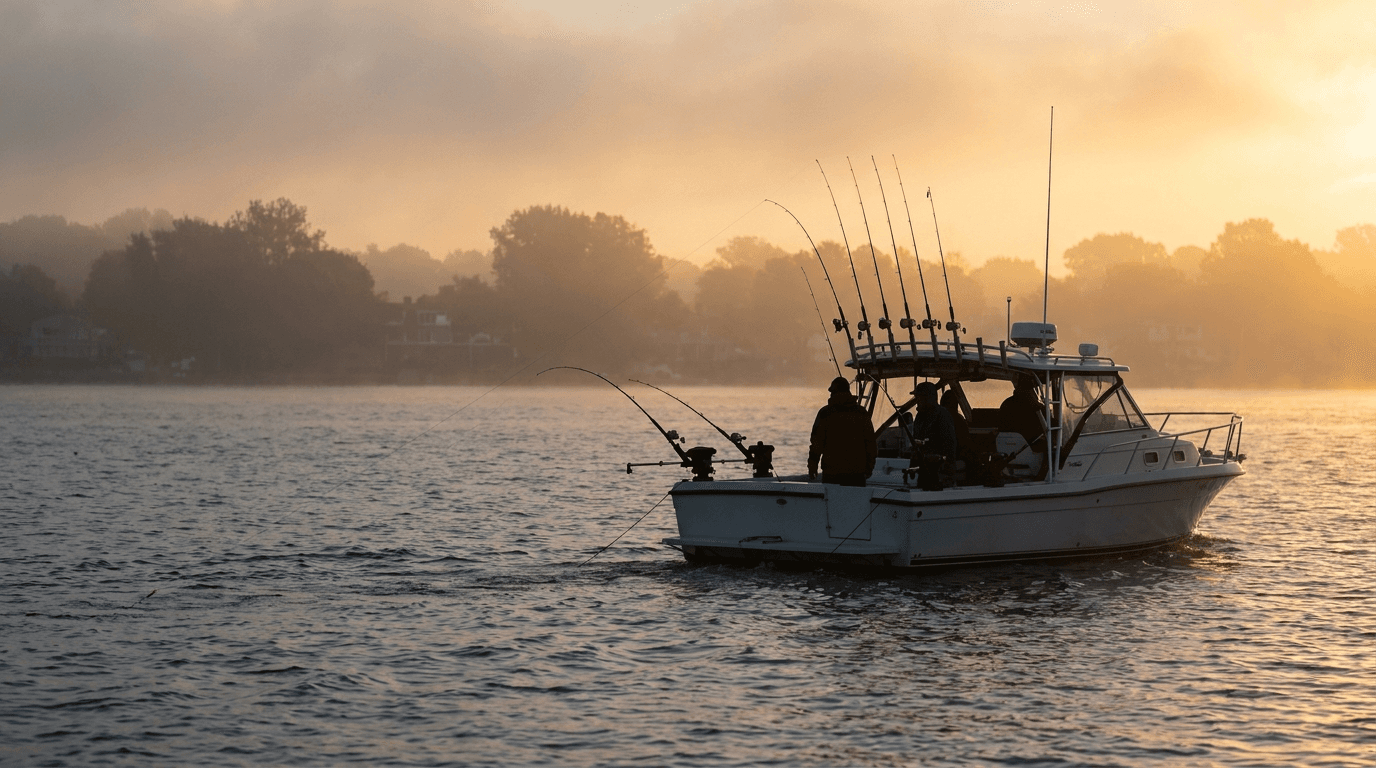
Most trips leave the dock between 6 and 7 a.m., before the wind picks up and while fish are still shallow and active. The technique is almost always trolling — crankbaits, spoons, or worm harnesses run at specific depths behind planer boards or on downriggers, covering water until the pattern shows itself. It's less about casting skill and more about the captain reading temperature breaks, bait balls, and the fleet around him.
When a rod loads up, the mate or captain handles the net. Your job is mostly to reel steadily and not horse the fish — walleye have soft mouths, and a rushed hookset loses more fish than a slow one ever will. A good July morning can produce limits for a full boat before lunch. A tough day in shifting weather might mean working harder for fewer, still-legal fish. Both are part of freshwater trolling on a lake this size.
Full-day trips run 7 to 8 hours and typically fish two or three distinct patterns as the bite moves through the morning. Half-day trips compress that into 4 to 5 hours and usually stick to one productive area rather than running around chasing a better bite.
A charter's real value on Erie isn't the boat — it's knowing which five square miles of a 9,900-square-mile lake are holding fish this week.
That's worth paying for even on a lake famous for how many fish it holds. Book with the season pattern in mind, confirm your license before you leave home, and the rest of the day tends to take care of itself. If you're still working out what to pack or what a first trip like this generally involves, the fishing charter packing list covers the gear questions this piece didn't get to.