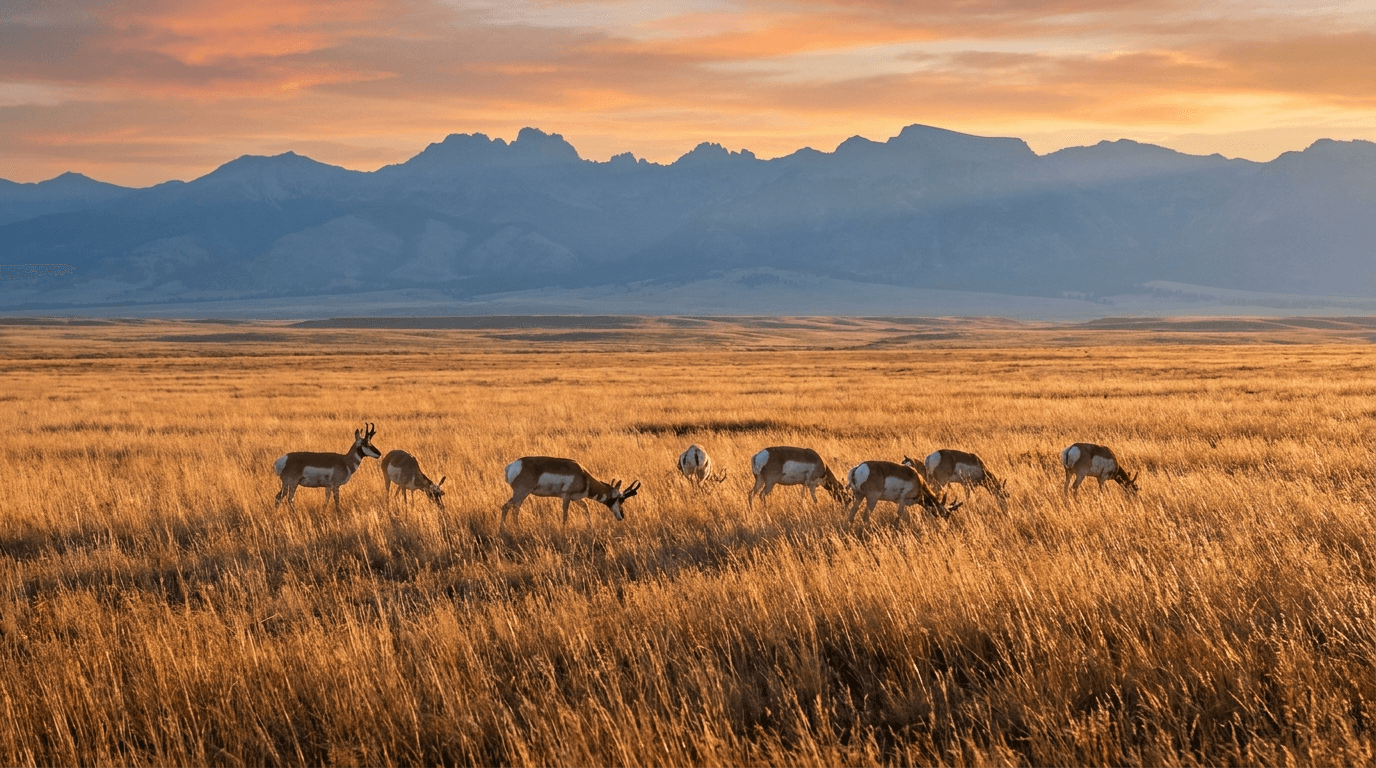
Every July, a strange little ritual plays out on the Wyoming Game and Fish website. Hunters who missed the spring draw start refreshing the leftover license page, waiting for a batch of antelope tags to reappear. In 2026, that batch showed up on July 8: 4,420 full-price pronghorn licenses left over after the main draw, with a second round of reduced-price doe/fawn tags following on July 15. If you're reading this in the same window, you haven't missed your shot at a Wyoming antelope tag this year. You've just missed the easy way to get one.
Pronghorn are the most forgiving big game animal Wyoming offers a nonresident, and also the most misunderstood. The state holds roughly half the pronghorn on the continent, the license is the cheapest big-game tag in the book, and a guided hunt runs a fraction of what you'd pay for elk. It's also a genuinely different kind of hunt than most people expect — flat, open, and a lot more about glass and stalk than sneaking through timber.
Two Seasons, Two Very Different Hunts
Wyoming splits its pronghorn season by weapon, and the two versions barely resemble each other.
Archery season generally opens August 15 and runs through the end of September, ahead of the general rifle opener — exact dates shift slightly by hunt area, so confirm the specific unit before you book. This is a decoy-and-water-hole game. Pronghorn rely on eyesight, not scent, so archers set up blinds on stock tanks or fields and let the animal come to them, or stalk in using a buck decoy to close the last hundred yards. Shots run short: 20 to 40 yards is typical for a blind setup.
Rifle season opens October 1 and runs into late November in most units. This is the hunt most people picture: spot-and-stalk across open prairie, glassing herds from a truck or a rise, then closing distance across ground with almost no cover. Shots stretch out — 200 to 400 yards isn't unusual, and a rangefinder matters more than camouflage.
Neither version takes long. Most outfitters book pronghorn as 2- or 3-day hunts, and success rates in good units run well above 80% for hunters who show up ready to shoot at distance.
That's a short trip for that kind of odds.
The License Puzzle: Draw, General, and Leftover
This is where pronghorn hunting gets confusing, and where most first-timers waste a year.
Wyoming requires nonresidents to apply through a draw for the vast majority of antelope hunt areas, even the "general" ones with large quotas. The regular application window runs from January through a June 1 deadline for deer and pronghorn — miss it, and the primary draw is closed to you for that license year. Nonresidents choose between a regular license (around $341 in 2026) and a pricier special license (roughly $1,215) that improves your draw odds through Wyoming's preference structure. Neither guarantees a tag in a popular unit; both are refundable if you don't draw.
Here's the part that actually matters if you're reading this after June 1: Wyoming runs a second chance. Any license left unclaimed after the main draw — because the drawn applicant didn't pay, or because a unit's quota simply wasn't filled — goes into a leftover pool. In 2026 that pool opened with a short reapplication window in late June, tentative results landed by July 8, and full-price leftover licenses went on sale first-come, first-served the same day. A second batch of reduced-price doe/fawn tags followed a week later. The leftover list runs through the season and is worth checking even in August or September for antelope, since quotas are large and demand for a $341 tag with an 80%+ success rate never quite matches supply.
Check current dates and unit-by-unit quotas directly at wgfd.wyo.gov before you apply or buy — Game and Fish sets exact deadlines and hunt-area numbers annually, and they move.
What a Guided Hunt Actually Costs in 2026
Pronghorn are the value play in Wyoming big game. A guided elk hunt routinely runs $6,000 to $12,000; a guided pronghorn hunt rarely breaks $4,000, license included or not.
Roughly a third of the price, for a much higher chance of tagging out.
| Hunt type | Typical length | 2026 price range | What's usually included |
|---|---|---|---|
| Fully guided, lodge-based | 3 days | $2,500–$3,500 | Guide, lodging, meals, transport on-ranch |
| Fully guided, premium ranch/trophy units | 3–5 days | $3,500–$4,500 | Guide, lodging, meals, higher-quality herds |
| Self-guided trespass fee | 3–5 days | $1,800–$2,200 | Land access only — you supply everything else |
License, tags, and Wyoming's nonresident conservation stamp are extra in almost every quote — outfitters price the hunt, not the state's cut. Ask for that separated out before you compare two prices, because a "$2,800 hunt" that includes the tag and a "$2,800 hunt" that doesn't are two different numbers.
Trophy fees are rare on pronghorn compared to elk or deer, but not universal. Confirm it in writing.
What to Expect on the Ground
Bring layers, not a wardrobe. Wyoming in September can hit 85 degrees at noon and drop into the 30s before sunrise — the same day. Wind is the other constant; a calm morning on the prairie is the exception, and it affects both scent (irrelevant to antelope) and your shot (very relevant at rifle distances).
A rangefinder is not optional gear here. It's the single piece of equipment that separates a clean rifle hunt from a wounded animal at 300 yards. If your outfitter doesn't ask about your comfortable maximum range before the trip, ask them the question yourself.
Days run long and mostly in a truck or on foot across open ground — glassing, repositioning, glassing again. It's less physically demanding than a mountain elk hunt and more mentally demanding than most people expect, because "just walk up on it" isn't really an option on flat ground where a pronghorn can see you from a mile out.
If you tip your guide at the end — and most hunters do, generally somewhere in the 10–15% range of the hunt cost for a successful, well-run trip — that's a conversation worth having before the hunt, not after. Our guide to tipping a hunting guide breaks down the ranges and when they shift.
Choosing an Outfitter
Pronghorn hunts are cheap enough that it's tempting to book on price alone. Don't. A few questions separate a good outfit from a disappointing one:
- Is the tag price separate from the hunt price, and does the quote include the conservation stamp?
- What's the actual acreage and is it a mix of public and private, or private-only trespass land?
- What's their three-year average success rate, broken out by weapon type?
- Is meat processing or field care included, or your responsibility?
- What's the cancellation and weather policy if a wildfire closure or an early snowstorm hits the unit?
None of this is legal advice, and it isn't a substitute for checking your own license eligibility and hunter education requirements with Wyoming Game and Fish directly. It's just the list of questions that keeps a $3,000 hunt from turning into a $3,000 lesson.
For more on separating a legitimate outfitter from a risky one before you send a deposit, see our broader guide to choosing a hunting outfitter. And if a pronghorn hunt is your first guided hunt of any kind, our piece on what to expect on a first guided hunt covers the etiquette and pacing questions that apply well beyond whitetail.
Wyoming's antelope herds aren't going anywhere, and neither is the leftover license list. If this year's window has already closed by the time you read this, mark your calendar for next January and start the draw process early — it's the cheapest big-game tag in the Rockies, and it's worth the paperwork.