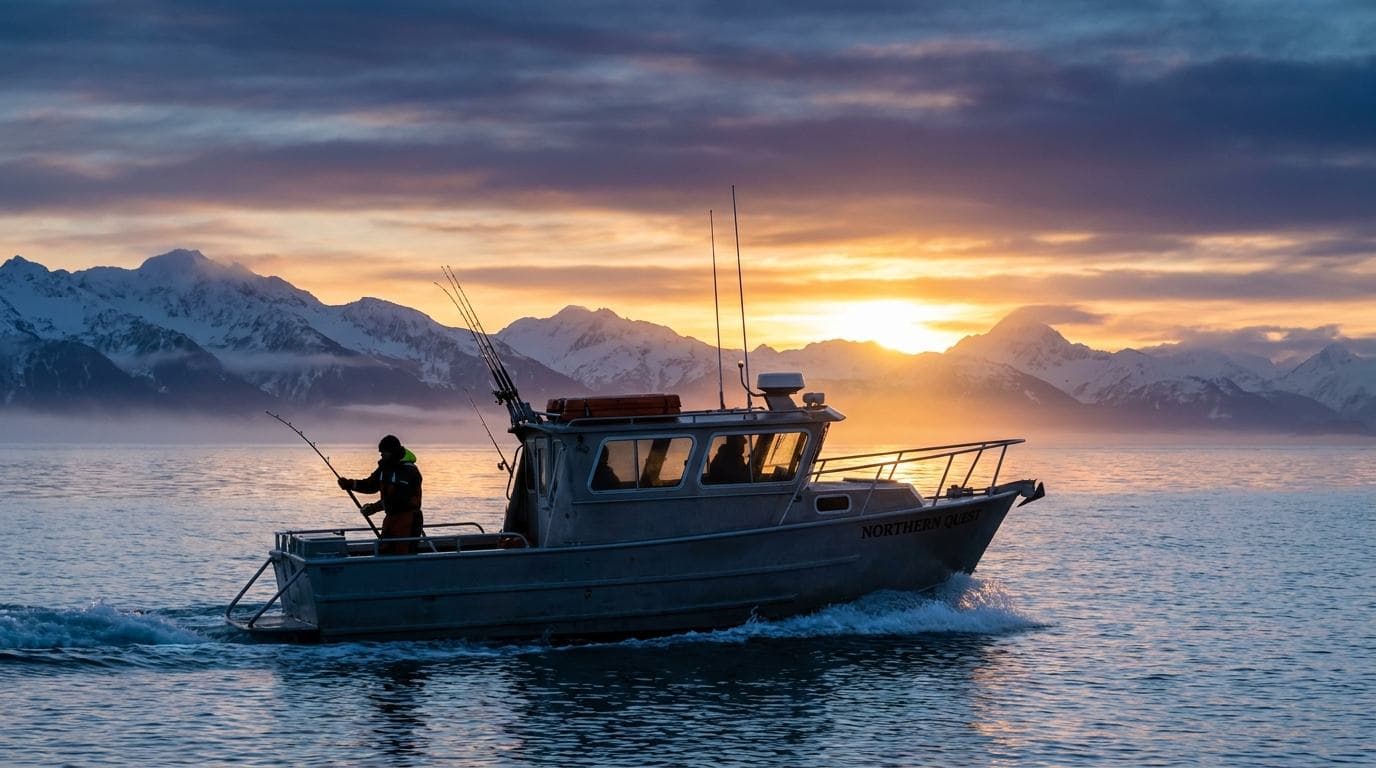
Alaska Just Extended Halibut Season — Here's What That Means for Booking
The 2026 halibut season in Alaska's charter waters runs May 1 through November 7 — 191 days, the longest stretch in recent memory. That's the headline. The part that actually matters for planning a trip is narrower: June through August is still where the fish, the weather, and the odds all line up.
Halibut don't read a calendar the way salmon runs do. There's no single week when "the bite turns on." What changes month to month is consistency. May can be excellent and can also blow out for a week straight. By July, boats are running most days, the water's calmer, and the fish that came up shallow to feed all summer are easiest to find.
Book early. Peak-season boats in Homer and Seward routinely sell out four to six months ahead, especially for July and August weekends.
What a Halibut Charter Actually Costs in 2026
Prices moved this year. Every charter halibut trip in Alaska now carries a $20 daily stamp fee, added on top of the base rate. Budget for it up front so the number on the dock invoice doesn't surprise you.
Full-day rates cluster in a fairly tight band depending on port and season:
| Port | Full-day rate (per person) | Notes |
|---|---|---|
| Seward | $365 (May) – $445 (June–Sept) | Closest major port to Anchorage; roughly 2.5-hour drive |
| Homer | $300 – $500 | Widest range of boat sizes and trip lengths |
| Private 6-pack (whole boat) | ~$1,800/day | Splits cheap across a group of five or six |
That's the base rate for a seat on a shared boat. It doesn't include fish processing. Vacuum-sealing and freezing your catch typically runs another $2 to $4 per pound, and shipping a cooler home from Anchorage can add $150 to $300 depending on weight and destination. Ask about both before you book — not at the dock, with a knife already in someone's hand.
A few things push the price around beyond the base rate. Halibut grounds sit farther offshore than most salmon water, so a real half-day halibut trip is rare — where one exists, expect smaller fish and a shorter run. Combo trips that add salmon or rockfish cost more than a halibut-only day but save you booking two separate charters. And a private boat, while pricier up front, often beats the per-person shared rate once you've got five or six anglers splitting it.
The Regulations That Catch First-Timers Off Guard
Alaska splits its halibut charter fishery into regulatory areas, and the rules genuinely differ between them — this is the part that trips up out-of-state anglers who assume "one fish limit" means the same thing everywhere.
Area 2C — Sitka, Ketchikan, Juneau
One halibut per day, and it has to fall outside a reverse slot limit: 34 inches or shorter, or 80 inches or longer. Charter boats here also can't retain halibut on Thursdays from June 18 through September 10.
Area 3A — Homer, Seward, Kodiak
Two halibut per day, but only one can be any size. The second has to be 27 inches or shorter. Set Tuesday and Wednesday dates through the summer are closed to retention as well.
Neither rule is a technicality you can talk your way around. A guide who runs these waters every week will build your trip around the closure calendar without you having to ask — but it's worth confirming before you book a specific date, especially if you're flying in for a narrow window.
Homer, Seward, or Kodiak — Which Port Fits the Trip
Three ports handle most of Alaska's halibut charter traffic, and they're not interchangeable.
Homer
Calls itself the halibut capital of the world, and the fleet size backs it up: more boats, more trip lengths, more price points than anywhere else in the state. It's also a five-hour drive from Anchorage, so budget a travel day each direction.
Seward
Sits about 2.5 hours from Anchorage, which makes it the practical choice if you're short on time or working around a cruise-ship layover. The grounds run slightly smaller on average than Homer's best water. The drive-time savings often win out anyway.
Kodiak
The outlier. Harder to reach, fewer operators, and genuinely bigger fish on average because the fishing pressure is lower. It's the right call when trophy potential matters more to you than convenience.
There's no wrong pick here. Just the one that matches what you're actually after.
What a Day on the Water Actually Looks Like
Most boats leave the dock between 5 and 6 a.m. Expect an hour or more of running time to reach productive grounds — halibut hold near structure on the bottom, often 200 to 600 feet down, and the run out is part of the day, not a delay before it.
Bring the motion-sickness pills if you're at all prone to it. This is open ocean, not a sheltered bay.
Gear is almost always provided: heavy jigging rods, circle hooks, and bait rigged for bottom fishing. Circle hooks are required in most Alaska halibut fisheries now, which actually helps — they hook fish in the corner of the jaw and make releasing an oversized fish much easier on the crew.
Landing a 40-pound halibut from 300 feet down is real work. It's not a cast-and-reel afternoon; plan on sore forearms the next day, especially if you hook into anything over 60 pounds. The crew gaffs and boats the fish — you mostly just keep cranking.
Back at the dock, most charters either clean your catch on-site or point you to a processor nearby. That's the moment to ask about the per-pound fee if you haven't already.
Booking Smart
A few things worth confirming before you put down a deposit:
- Ask which regulatory area the boat fishes and what the current bag limit and closure dates are for that specific week.
- Confirm whether processing and shipping are included or billed separately — this can swing the real cost of the trip by hundreds of dollars.
- Check the weather-cancellation and rebooking policy. Alaska weather changes fast, and a captain who's upfront about how cancellations work is usually the one who's been doing this a long time.
Booking direct with the charter — a phone call or an email to the captain rather than a third-party listing — is usually the simplest way to get straight answers to all three questions before you're committed.
Want more of these before you pick a destination? The guides library has season-by-season breakdowns for other fisheries worth comparing against, and twelve questions worth asking any fishing guide covers the vetting conversation in more depth than bag limits and boat rates alone.