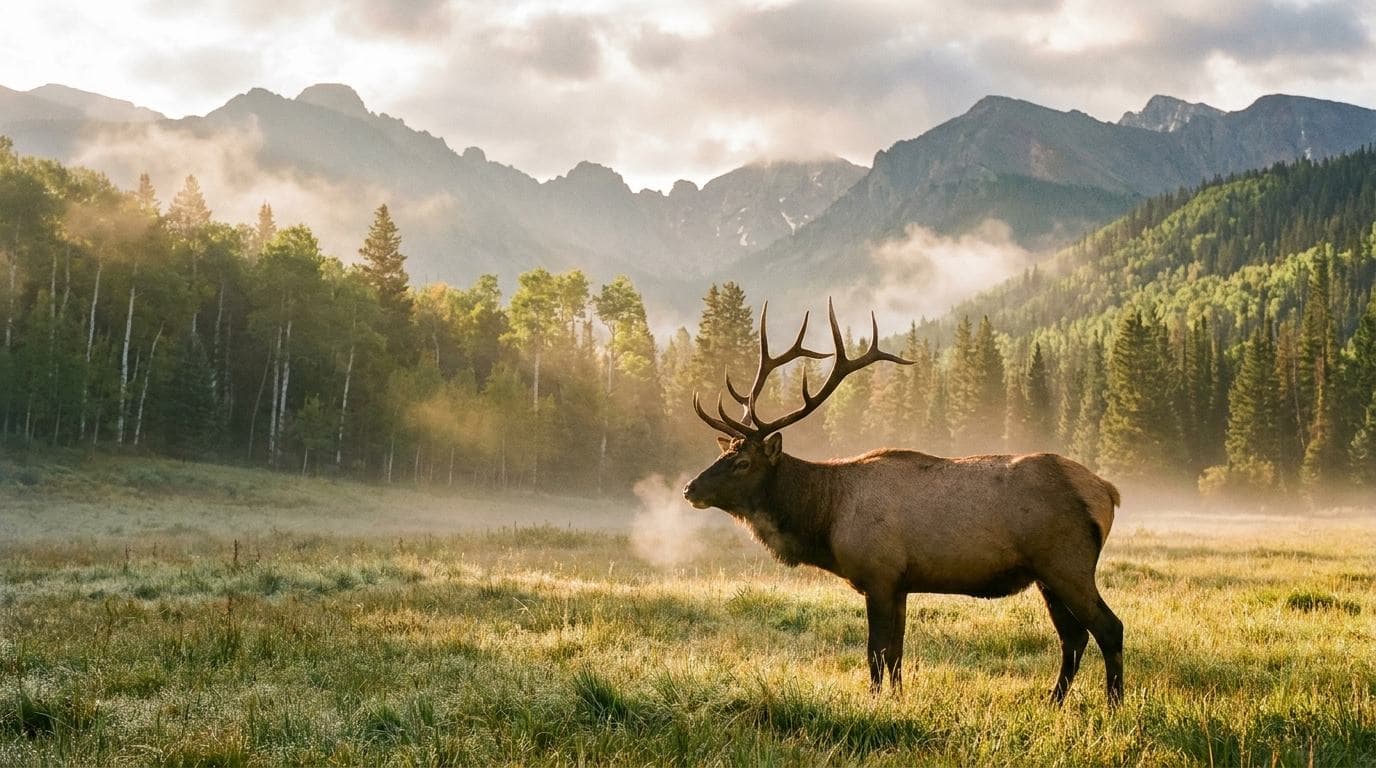
Why Colorado is still the first name people say
More elk live in Colorado than anywhere else in the country, and the state issues more nonresident tags than its neighbors combined. That's the pitch you'll hear from every outfitter's website. It's also, mostly, true — which is exactly why the state's draw system, season structure, and outfitter pricing have gotten more complicated, not less, over the last few years.
If you're planning a guided elk hunt in Colorado, here's what it actually costs in 2026, when the seasons run, and the tag problem nobody mentions until you've already wired a deposit.
Short version: the tag is the hard part. The elk, comparatively, is the easy part.
What a guided elk hunt in Colorado costs in 2026
Prices swing hard based on land access, season, and how badly you want a mature bull instead of meat in the freezer. Sourced ranges from active Colorado outfitters this year:
| Hunt type | Typical length | 2026 price range | What's usually included |
|---|---|---|---|
| Public-land wilderness rifle | 5–7 days | $5,750–$7,500 | Guide, meals, wall-tent or cabin |
| Private-land rifle (landowner voucher) | 5–7 days | $6,900–$9,500 | Guide, meals, better tag odds |
| Horseback backcountry | 5 days | $5,500–$7,000 | Stock, guide, wall-tent camp |
| Cow elk / meat hunt | 3–5 days | $2,000–$4,000 | Guide, simpler logistics, no trophy pressure |
| Trophy bull, premium ground | 7+ days | $12,000–$25,000+ | 1:1 guide, prime private acreage |
Most outfitters want a deposit to hold your dates — commonly half the total, though some run a flat deposit (one Colorado outfit asks for $3,500 plus a signed contract regardless of package price). Ask what happens to that deposit if the season gets cut short by fire closures or you can't draw a tag. Get it in writing before you send money.
Colorado's 2026 elk seasons
The season you book changes everything else about the hunt — crowding, weather, rut behavior, and price all move together.
- Archery: September 2–30. Bulls are still bugling early in the window; expect more competition from other hunters in popular units.
- Muzzleloader: September 12–20, a short overlap with the tail end of archery.
- First rifle (limited units): October 14–18.
- Second rifle (deer and elk): October 24–November 1 — statistically the highest-success rifle window in many units.
- Third rifle: November 7–17.
- Fourth rifle (limited elk): November 18–22.
- Late rifle: runs November 23, 2026 through January 31, 2027, with exact dates set per game management unit.
Book the season, not just the outfitter. A camp that crushes it during second rifle can be a completely different experience during late-season cold and pressured elk.
The tag problem nobody mentions on the sales call
Here's the part that catches first-timers: Colorado moved nonresident over-the-counter archery elk to a draw starting in 2025, and 2026 keeps that structure, with only a narrow set of nonresident OTC archery options left in eastern plains units. If you're reading this in July planning a fall hunt, the main draw application deadline — April 7 — has already passed for this year.
That's not the dead end it sounds like. Many outfitters hunt private land using landowner vouchers, a separate allocation that lets landowners issue a share of tags outside the general draw — up to 15% of general-quota elk licenses east of I-25, and 10% west of it, depending on the unit. Ask any outfitter point-blank: "is this hunt on a landowner voucher, or does it require me to draw?" If the answer is vague, that's your answer.
If this year's window has closed for you, the move is to apply for the 2027 draw the moment applications open, typically in early spring — mark it now so you're not scrambling again next April.
What success actually looks like
Every outfitter site shows a wall of dead bulls. The real numbers are more honest and more useful. Statewide, Colorado elk hunters average roughly 18% success across all weapons and seasons combined. Archery alone runs closer to 10–15%. First rifle season is the strongest public-land window, often 20–25%, and limited-entry units can push 25–35%.
Guided hunts on quality private ground run well above the statewide average — outfitters report bull success in the 40–70% range, with the top end concentrated on managed private land with a 1:1 or 2:1 guide ratio. A 2:1 ratio is the minimum worth paying for; anything looser and you're often waiting your turn to hunt.
Ask for last year's actual harvest numbers, not "our success rate is excellent." An outfitter with nothing to hide will tell you the real percentage, including the years it wasn't great.
If they won't, walk.
What a week in camp actually looks like
Days start well before daylight — you're hiking to a glassing point or a known travel corridor in the dark, then sitting still while the guide reads wind and elk movement through binoculars. Archery hunts lean on calling and close-range stalking; rifle hunts lean on glassing from distance and closing ground carefully once a bull is picked out. Either way, expect five to nine miles of walking a day at 8,000–10,000 feet of elevation, often off-trail.
Evenings are short: field-dress and quarter whatever came down, hang or ice meat, eat, sleep, repeat. If you're not currently doing any cardio at altitude, start well before your hunt dates — nothing ends a trip faster than a hunter who can't keep pace on day two.
Before you book
Vet the outfitter the way you'd vet any five-figure purchase: ask for three references from the last two seasons, confirm the guide-to-hunter ratio in writing, and get the cancellation and weather policy on paper before you send a deposit. Our guide to choosing a hunting outfitter covers the full list of questions worth asking, and if you're wondering what's fair to hand your guide at the end of the trip, we cover real ranges in how much to tip a hunting guide.
Colorado elk hunting rewards patience more than luck — patience with the draw system, patience glassing a hillside for three hours, patience picking an outfitter who'll tell you the truth about your odds. Get those three right and the rest of it takes care of itself. For more first-hunt breakdowns like this one, browse the guides library.