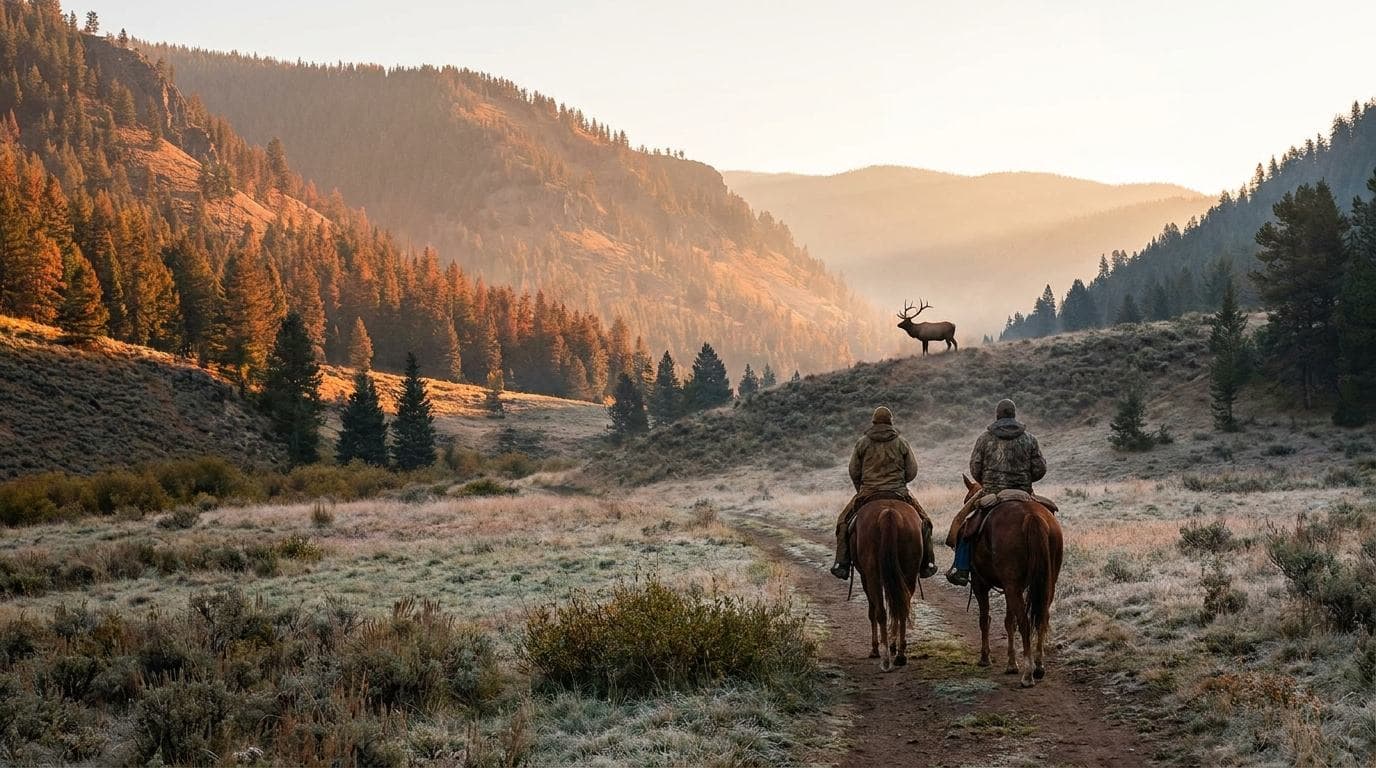
Most first-time elk hunters come from a deer hunting background. They assume the transition is mostly about scale. Bigger animal, bigger landscape, same general idea. That assumption gets tested fast in the mountains.
Elk hunting is physically demanding in a way that deer hunting usually isn't. You'll be on your feet 8-10 hours a day at elevations between 8,000 and 11,000 feet, in terrain that doesn't care about your knees. A good guide can put you in position to kill a bull. He can't do the hiking for you.
Here is what a first guided elk hunt actually costs, how to find and vet an outfitter, what the days look like, and how to show up ready.
The real cost of a guided elk hunt
Outfitter fees are quoted as a single number, and that number is large. It is also not the full picture.
Guided elk hunts on public land typically run $5,000-$7,500 for a 5-7 day hunt. Private-land hunts range from $7,500-$12,000, with trophy operations going higher. Those are the outfitter fees. Before you set a budget, add:
- License and tag. In Colorado, a nonresident rifle elk license runs around $690 plus a $100 habitat stamp. New Mexico, Wyoming, and Idaho have similar nonresident tag costs. Draw odds vary significantly by unit. Some zones require applying for years to accumulate enough preference points to draw a tag at all.
- Guide gratuity. Fifteen percent of the hunt cost is the standard. On a $6,000 hunt, that's $900 to budget from day one, not figure out afterward.
- Meat processing and shipping. An adult elk yields 200-300 pounds of meat. Processing runs $1.00-$1.50 per pound. Shipping frozen meat home costs $200-$500 depending on distance and carrier.
- Travel. Flights, rental car, and fuel to reach a remote camp. The drive from the nearest airport to the trailhead is often 3-4 hours.
A realistic total for a first-timer on a $5,500 Colorado public-land rifle hunt: $5,500 outfitter fee, $800 in tags and licenses, $900 gratuity, $400 meat processing, $350 freight, $600 travel. That comes to roughly $8,550 before gear. Budget $9,000-$10,000 and you won't be caught short.
Choosing the right hunt for a first trip
Rifle hunting gives you a longer effective range and a more forgiving shooting situation than archery. For a first elk hunt, rifle is the practical choice unless you've been bowhunting seriously for years and can reliably shoot under 40 yards with adrenaline running.
Public land vs. private land matters more than most outfitter websites will tell you upfront. Public-land hunts are cheaper, but hunter pressure is higher and success rates are lower, often 15-25% during general season. Private-land operations routinely hit 60-80% success rates, but the cost reflects that. If a successful harvest is the priority on your first trip, a private-land hunt or a quality concession area is worth the premium.
For states: Colorado, Idaho, New Mexico, and Wyoming all have established outfitter industries and healthy elk numbers. Arizona draws produce some of the highest-quality bulls in North America but require years of accumulated preference points. For a first hunt on a 12-18 month planning timeline, Colorado and Idaho are the most accessible for nonresidents.
How to vet an outfitter before you send a deposit
Every outfitter website looks the same: cinematic photos, glowing testimonials, decades of combined experience. None of it tells you much. Here is what to actually check:
- Ask for the outfitter's current state license number and verify it with the state wildlife agency. Legitimate outfitters give you this without hesitation.
- Ask for three recent client references, not names they have pre-selected, but clients from the past two seasons who you can call yourself. Ask about guide-to-hunter ratio, camp conditions, and how the outfitter handled something that went wrong.
- Ask what the refund policy is if the draw fails or a family emergency cancels your hunt. The answer tells you a lot about how they treat clients when things don't go to plan.
- Ask how long the lead guide has been working the specific unit you will be hunting. A guide who has covered the same drainages for ten years knows the elk in a way a newer hire doesn't.
Guide-to-hunter ratio matters. Some operations book four to six hunters per guide during peak season. A 2:1 or 1:1 ratio means more time in quality positions and more coaching in the field. Ask specifically what ratio applies to your hunt dates.
Getting physically ready
Guides have a phrase for the hunter who shows up undertrained: "camp potato." It is not flattering, and it is not fair to the guide who has to shorten days or avoid the best country because someone can't cover the ground.
The minimum: you should be able to hike 3-5 miles with a 20-25 pound pack over uneven terrain without stopping. More is better. Start training 4-6 months out, not four weeks before. Cardiovascular fitness matters as much as leg strength at altitude.
If you live at low elevation and are hunting above 8,000 feet, arrive 2-3 days early to acclimate. Altitude sickness (headache, fatigue, nausea) is real and can end a hunt. Arriving the night before a 4 AM wake-up is a reliable way to spend your first morning feeling terrible.
What a typical hunt day looks like
Camp wake-up runs 4:00-4:30 AM. You eat, gear up, and load into trucks or onto horses in the dark. By first light you are in position on a ridge, a saddle, or a meadow edge where the guide has been scouting elk movement. The first two hours after sunrise and the two hours before dark are when elk are most active. Midday means covering ground, glassing new country, or resting at camp.
Expect to return to camp by 9-10 PM on active hunting days. Twelve to fifteen hours out is normal. You will be tired.
Most of the hunt is patient observation and quiet movement. Your guide is reading wind, listening for bugles, deciding when to call and when to stay still. Listen to him. Guides who have worked the same country for years are reading signals that take seasons to learn to see. The hunters who ignore their guide rarely see elk.
Success rates and what to expect
The average harvest rate on public land in the West runs about 15-20% for general rifle season. Four out of five hunters come home without an elk, even on guided hunts. Private-land operations quote higher numbers, and the good ones deliver on them, but no one can guarantee a kill.
The first-time elk hunters who come back are usually the ones who went in with realistic expectations. The ones who don't are usually the ones who spent $9,000 expecting a guarantee and got a five-day education in the mountains instead. That education has real value. Resentment when it doesn't match an unrealistic expectation helps no one.
What to pack
Your outfitter will send a specific gear list. Follow it. Three things first-timers consistently underinvest in:
- Boots. The most important gear decision you will make. Well-fitted, broken-in mountain hunting boots with ankle support and waterproofing. Never wear new boots to the trailhead.
- Base layers. Merino wool or synthetic moisture-wicking material against the skin. Cotton is genuinely dangerous in cold, wet mountain conditions.
- Binoculars. A quality 8x42 or 10x42 binocular matters more than most rifle accessories. You will spend hours glassing.
You don't need $3,000 in gear. You need the right things in good condition, worn in before the hunt so nothing surprises you when you are five miles from camp and it starts raining.
Finding a guide
Most quality outfitters don't have large advertising budgets. They fill their seasons on repeat clients and word of mouth. When you search online, you often find the operations that spend the most on ads, not necessarily the ones with the best track records.
That's a reason to book directly with the outfitter rather than through a booking agent who has never set foot in the country you're hunting. Referrals, state licensing board lists, and your own vetting questions will surface better operations than ad budgets do. For more on running that vetting — and on tipping, packing, and what other first hunts look like — read how to choose a hunting outfitter or browse the rest of the guides library.