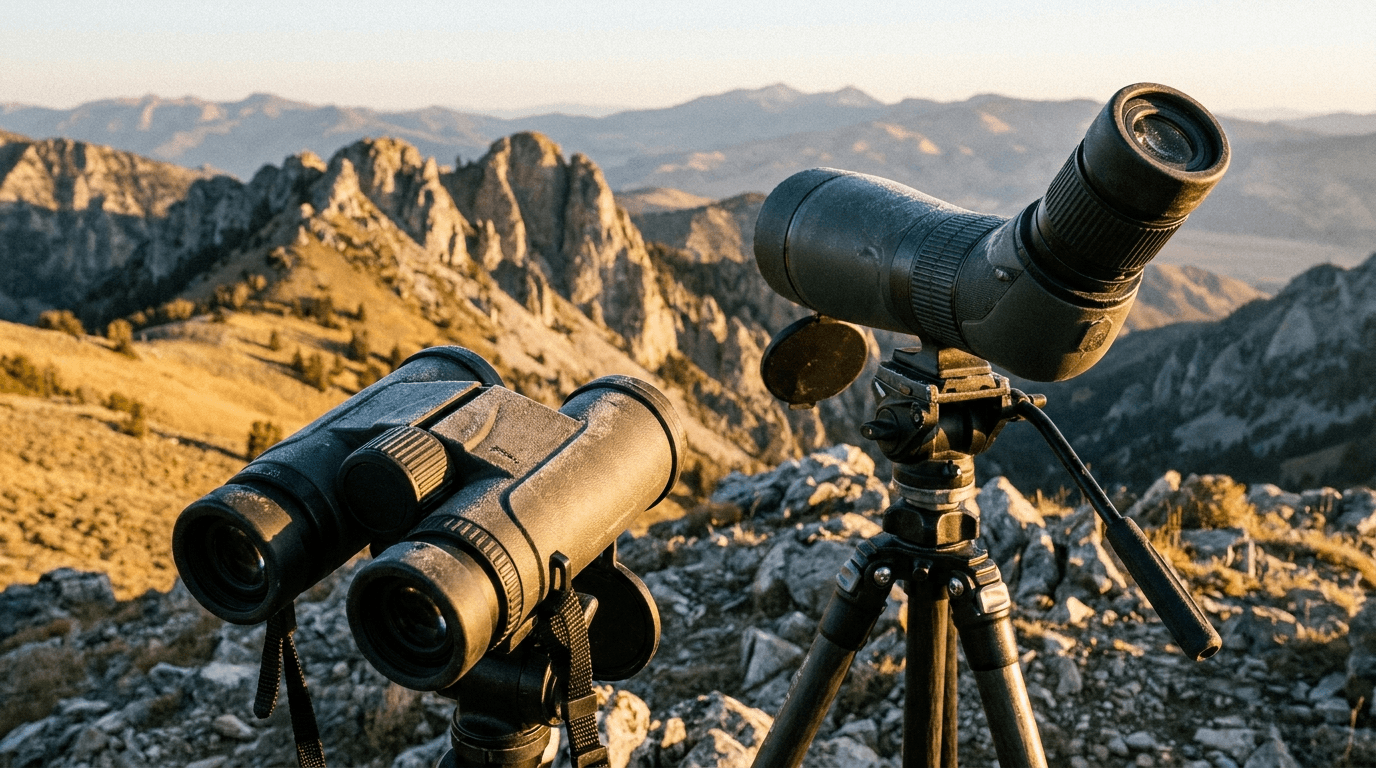
The hunters who fill tags in the West do a surprising amount of it sitting down. They pick a vantage, settle in behind a tripod, and take a mountain apart piece by piece while everyone else burns boot leather. It sounds backwards until you watch it work. A good glassing system will find a buck bedded at 800 yards that you would have hiked within 50 yards of and never known was there.
That matters most on public land. A mule deer that has survived a few seasons doesn't blow out of his bed at the sound of boots on scree. He tucks his chin, holds tight in the shadow under a rimrock, and lets you walk past. The only way to beat that animal is to find him before you're inside his bubble — with glass, from a long way off — and then plan the stalk on your terms. Come in from above an hour later, wind in your face, and the whole thing was decided back at the tripod.
Here's how to build the system: which optic does which job, why the tripod isn't a maybe, and the technique that turns an hour on a ridge into found animals instead of a scenic sit.
Binoculars find. The spotter decides.
These are two different jobs, and mixing them up costs you country. Binoculars are the search tool. When you are working a canyon face or a 300-yard-wide bowl, you need field of view and speed, and that's what a bino gives you. The spotting scope comes out after the binos have found something — a leg, a patch of tan, a dark horizontal line under a juniper — to answer two questions: what is it, and is it worth the stalk?
Try searching for deer through a spotter cranked to 45x and you'll understand the split fast. The field of view is a postage stamp of hillside, your eye fatigues in minutes, and you crawl across country a sliver at a time. A hunter running a spotter-only setup covers maybe a third of the ground per hour that a bino-first hunter does.
Find with the binos. Decide with the spotter.
Picking your bino magnification
The 10x42 is the default western binocular for good reason. It's light enough to use handheld while you move and steady enough on a tripod for long stationary sessions. If your hunting leans toward sitting vantage points, step up to a 10x50 or 12x50 — the bigger objective pulls in more light, and western hunting is largely won at twilight and in shade, exactly where that extra light shows.
For big, open country — pronghorn basins in Wyoming, desert mule deer in Nevada, sheep above treeline — a 15x56 or 18x56 bino deserves a hard look. At that power you're married to the tripod, no argument. But in flat, open terrain you're effectively carrying a compact spotting scope, and that trades well against packing both a 10x bino and a full spotter up the mountain.
Elk in timber are the exception. Stay at 10x. The wider field of view catches a flick of movement in broken cover that a 15x or 18x walks right past.
The spotting scope
An 80mm or 85mm objective with a 20-60x zoom is the standard for western big game, and there's little reason to fight it. Push past 85mm and the weight climbs faster than the image improves — this thing rides in your pack for miles. The top of the zoom range is mostly theoretical anyway; heat shimmer makes 60x unusable much of the day, and most of your real work happens between 30x and 45x.
Choose an angled body over a straight one for stationary glassing. You set the tripod lower, look down into the eyepiece, and your neck thanks you two hours into a ridge session. On glass quality, be honest about your budget: flagship glass like Vortex's Razor line is genuinely better at the edges and in low light, but a mid-tier scope such as the Viper HD gets soft above 40x and is still plenty clear at 30x to judge antlers. If the money you save finishes out your tripod, that is the better kit.
The tripod is not optional
Plenty of hunters buy good binos and then rest them on a pack or brace them against a tree. That works at 200 yards. At 600, an unsupported image costs you a third of the animals that are actually there, because the details that give a bedded deer away — the edge of a tine against gray brush, the slightly-too-dark rectangle of a body in hillside shadow — never resolve in glass that bounces with your pulse.
Put a 10x42 rock-steady on a tripod and it shows you roughly what a handheld 15x would.
Same glass, more animals. That's the whole argument.
You don't need a $400 tripod for binoculars. A fluid head or a solid ball head in the $150 range on $100 travel legs handles most western hunting. What you can't live with is a cheap friction head that drifts — the image slides off your grid every time you let go, and by day three you'll want to throw it off the rim. Most experienced western hunters run one tripod for everything, binos and spotter both, through the same Arca-Swiss head. Get the system mounted, balanced, and familiar before the season. Opening morning in the dark is a bad time to learn your gear.
Build a real glassing station
A glassing station is a position you chose, not the spot where you got tired. It needs four things:
- Visibility. A vantage that looks across country, not up a slope. You want drainage bottoms, north-facing aspects, and timber edges laid out in front of you. A spot that costs 45 minutes of hiking but shows three drainages beats a closer seat that shows one face.
- Shade. Glassing from a sunlit position into shadow is a losing fight — your eyes keep adjusting to the bright foreground and give up detail in the dark pockets where animals actually bed. Sit in shadow when you can. You're also no longer a silhouette on a skyline, which the deer appreciate less than you do.
- Stable ground. Spend the few minutes to level the tripod on rock or firm soil. Loose scree that shifts under a leg every time you touch the head will slowly drive you insane.
- Comfort. This is the one hunters underestimate. Nobody glasses well for 90 minutes with a back that quit at 20. A foam pad, a small chair, a stuff sack under your sit bones — whatever keeps you still. The hunters who find animals are the ones who stay put.
Grid the face — at half speed
New glassers move too fast. They scan a hillside in three minutes, see nothing obvious, and move on. A patient glasser can spend 45 minutes on that same face and turn up two bedded deer that were invisible at scanning speed. The animals didn't move. The pace did.
The grid itself is simple. Pick two landmarks — a rock, the edge of a tree line — that frame a vertical strip. Glass that strip bottom to top. Shift one strip-width over and do it again until you have covered the face. The hard part is holding your place, so lean on natural boundaries where they exist: a rimrock across the canyon, a drainage below, the timber edge above. Where they don't, pause at each strip and fix a landmark before you move.
Whatever pace feels thorough, cut it in half. And remember you're not looking for a deer — your eye will find a whole deer standing in a meadow without any system at all. You are looking for pieces of one: a horizontal line where the terrain shouldn't have one, a patch of tan a little too uniform for the rock around it, one ear twitching on a hillside that is otherwise still.
Match the search to the clock, too. At first and last light, work meadows and feeding areas and watch for movement. Through midday, shift to shaded north slopes, juniper pockets, and the dark ground at the base of rimrock. The country worth glassing changes across the day, and your pattern should move with it.
Mule deer and elk read differently
For mule deer, once temperatures climb past about 70 degrees, the buck you want is in the coolest dark spot on the mountain and he's staying there from mid-morning until late afternoon. Give the sunny flats a quick pass, but spend your prime sitting time on north-facing shade.
Elk run on thermals, and more predictably than deer. Cool morning air drains downhill, and elk feed toward the upper edges of meadows as it does. Evening reverses the flow and pulls them lower. In broken timber you'll often hear elk before you see them — a bugle at 500 yards in dark cover is a reason to sit very still and watch the edges, not a starting gun.
When it's worth hiring the glass
Everything above is learnable, but not quickly. The optics are actually the fast part — you can buy a dialed kit in an afternoon. Knowing which basin holds deer in the third week of October takes seasons, and that's the honest case for going guided on a first western hunt or a new species. An outfitter has already spent those seasons behind glass in that unit, and a week of watching one work a mountain will teach you more about glassing than a year of doing it alone. If that's the version of this hunt that makes sense for you, timberandtackle.guide is where independent guides and outfitters run their books — you book the guide directly, and the trip price goes to the person who earned it.