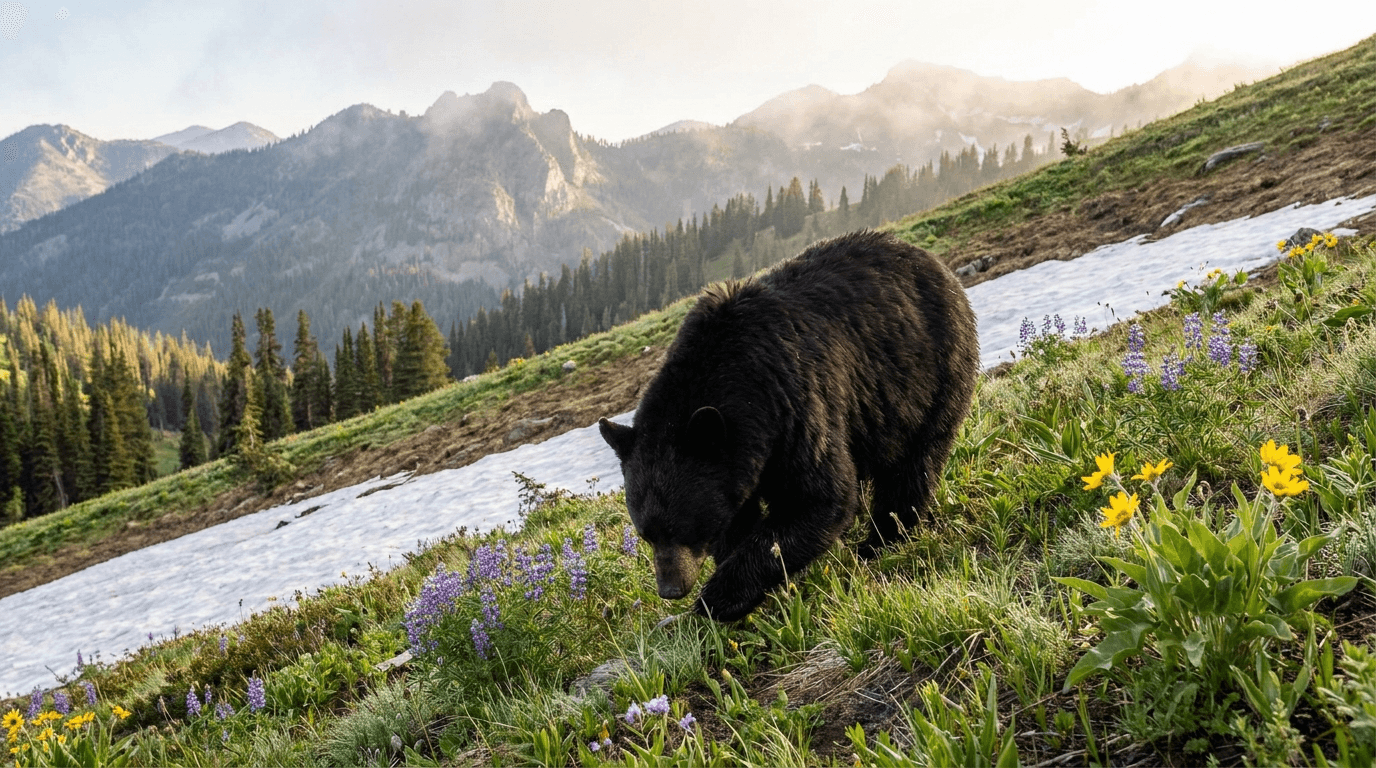
Every fall, elk hunters drive past some of the best bear country in the West without a second look. Fair enough. In September the elk tag runs the show. But those same mountains in May are a different place entirely: empty trailheads, snow pulling off the south slopes, and bears out in the open, head-down in new grass, feeding on a schedule you can nearly set a watch to.
Spring spot-and-stalk black bear is one of the most accessible big-game hunts in the West and one of the least crowded. Idaho sells general-season black bear tags over the counter, and a nonresident pays $41.75 for a reduced-price bear tag in designated units, on top of a nonresident hunting license. Spring seasons open April 1 in some units and April 15 in most, and close between May 22 and July 31 depending on the unit; the Idaho Big Game Seasons and Rules brochure lists each unit's dates. Montana's spring season covers April 15 through May 31 in most units, also over the counter. Wyoming and Oregon fill out the map for hunters who already know that country.
If you apply for elk in any of these states, you already know the ground. The rest is learning how bears use it in spring.
Why Spring Bears Are a Different Animal
A bear coming off the den is hungry and single-minded. It feeds head-down on fresh grass, skunk cabbage, and ant colonies for twenty minutes at a stretch without lifting its eyes, which hands you approach windows you'd never get on elk. Bears also aren't wired to check their back trail the way deer are. They're watching the food, not the ridge behind them.
The other reason to go in spring is the hide. A May bear carries a coat that hasn't been rubbed on deadfall or chewed up by summer insects. If a rug or mount is part of the plan, May is your window; by late June in low country, hide quality drops fast.
Tags, States, and Timing
Idaho is the natural starting point. Roughly 60 percent of the state is public land, more than 33 million acres, and its general spring season runs longer than anywhere else in the West. Some zones offer a second tag, and nonresident pricing stays reasonable by western standards.
Montana bans both baiting and hounds, which makes it a pure spot-and-stalk state by regulation. That's not a mark against it. Hunters who commit to learning Montana terrain tend to take better bears than the crowd sitting over bait ever sees. Just mind the calendar: the season closes May 31 in most units, so plan for April or early May.
Read the current regulations before you commit to anything. A handful of states have dropped spring seasons over the past decade, and unit-level closures move year to year. Start with this year's regs from the state agency, not a forum thread from three seasons back.
Follow the Green-Up
Bears den low and emerge low, then chase the fresh growth uphill as the season moves. In early April, expect them between 3,000 and 5,000 feet on south-facing ground. By late May in Idaho or Montana, you might be glassing feeding bears at 8,000 feet.
The snow line is your guide. Bears stack up just below the retreating snowpack, where the newest, most tender growth comes in. A few terrain features earn priority:
- South and southwest benches that shed snow weeks ahead of north-facing slopes and green up first
- Avalanche chutes, where scoured ground and packed debris push up early vegetation that just-emerged bears work hard
- Burns five to fifteen years old, thick with brush, downed logs, and the ant colonies bears mine for protein
- Wet, low drainages holding skunk cabbage, a dependable early food source before much else greens up
As April turns to May and May turns to June, ride that elevation band uphill. The bears go where the grass goes.
Glassing Is the Hunt
Call spring bear hunting 80 percent glass time and you won't be far off. You're not still-hunting timber. You're finding a vantage over south-facing country and grinding the binoculars until something dark materializes.
Give any decent glassing spot an hour, minimum. Plenty of hunters pull up, sweep for twenty minutes, and roll on — and that's exactly how you miss the bear bedded in shade at midday that steps back out to feed in the last two hours of light. Get comfortable and stay put.
Black fur at distance is harder to pick out than you'd think. It swallows shadow and disappears against burned timber, dark rock, and timber edges in a way tan and brown animals don't. You're not always looking for a clean silhouette. Often it's just a dark shape moving against a background that doesn't quite fit.
Glass quality matters more here than on almost any other hunt. A good 10x42 binocular is the working tool, and a 15x on a tripod earns its weight in open basins where you're trying to read color phase and body size at 600 to 800 yards. A spotting scope closes the gap between "there's something dark" and "I'm going." At high magnification you can check the hide for rubs and judge maturity — ears that look small relative to the head usually mean a mature boar.
Closing the Distance
Found a feeding bear? Before you move a step, pick out fixed landmarks around the animal. The country reads completely differently once you drop off the ridge into the drainage, and those reference points are how you relocate the spot where the bear was standing.
Wind matters every bit as much as it does on elk. A bear's nose is excellent, and one whiff at close range ends the stalk without a sound. Work out the thermals before you commit: spring mornings pull air downhill, afternoons push it back upslope. Plan around the wind you'll have at shooting distance, not the wind you have right now.
Move fast early, while you have cover and distance to burn. At 200 yards, slow everything down. Bear hearing is better than most hunters give it credit for, and crusted spring snow in shaded timber is loud. Pick every step.
Most spring bear hunters carry rifles, and for good reason. Typical shot distance on spot-and-stalk bears runs 100 to 250 yards, and a centerfire gives you far more margin than archery gear. Your elk rifle is the right rifle — 7mm, .30-06, .308, and 6.5 Creedmoor all do the job.
Shot Placement
If you take one section of this seriously, make it this one.
Bears aren't hard to kill with a well-placed bullet. They're hard to recover after a marginal one, and they'll often soak up a hit that would flatten a deer without showing much reaction. A wounded bear in thick spring cover is a problem you do not want.
The vitals on a black bear sit in an 8-to-10-inch circle behind the front leg, centered in the body at that point — and the bear's outline will lie to you about where that is. The scapula rides farther back than on a deer or elk, and the belly line hangs lower than on any game animal of comparable size. Hold where the shoulder looks prominent and you're into scapula or spine. Hold for the visual center of the body and you're in the gut.
Broadside, put the crosshairs just behind the crease of the front leg, one-third up from the bottom of the chest. That's the lungs. Quartering-to, drive the bullet toward the off-side shoulder so it angles through the chest. Both shots work when you execute them.
Then wait. Give a well-hit bear 30 minutes before you follow. Even clean lung hits almost always end with the bear piling into cover, so mark where it stood and the line it took before you move.
Bullet construction matters too. Barnes TTSX, Nosler AccuBond, and Hornady ELD-X all penetrate reliably on bear. A standard cup-and-core deer bullet can come apart on a big boar's thick hide and rebuilding spring fat, especially at steep angles or close range.
Meat, Hide, and the Haul Out
A May bear that's been living on grass and skunk cabbage carries mild, clean-tasting meat. The bad reputation belongs to fall bears that spent weeks on fish and carrion. Most hunters who actually cook a spring bear come away surprised.
Once daytime temperatures climb past 50 degrees, cool the carcass fast. That thick hide holds heat, so skin the quarters and get them into breathable game bags with air moving around them as soon as you can. And plan for weight: the hide alone on a big spring boar can run 60 to 80 pounds. Two trips is the honest plan, and a real frame pack makes them possible.
The rest of the kit is your elk kit, with two notes. Spring puts hard snow, loose talus, mud, and dry ridge under the same boots in a single morning, so wear a stiff-soled mountain boot that can handle all of it. And spring weather swings from below freezing at first light to shirtsleeves by noon to thunderstorms at three, so a breathable midlayer beats one heavy jacket. A sharp skinning knife and a bone saw round out the list. Nothing else is bear-specific.
Going Guided
Plenty of hunters run this hunt solo, and it's a fine DIY entry into western big game. Still, there's a real case for hiring out the first one. Judging bears is genuinely hard — sows and boars look alike at 600 yards, most spring states protect sows with cubs, and cubs can be bedded out of sight while the sow feeds. An outfitter who has watched the same slopes green up for twenty springs knows which chutes hold bears in which week, and has the stock or the packs to solve the haul. If that's the version you want, timberandtackle.guide is where independent guides and outfitters run their own books, and the trip price goes to the people actually running the hunt. For a sense of the numbers, here is what a guided black bear hunt in Maine costs; that one is a fall hunt over bait or hounds, not spring spot-and-stalk, but it lays out what an outfitter's package covers. Either way, check the current spring regs before you go — and go while the mountains are still empty.