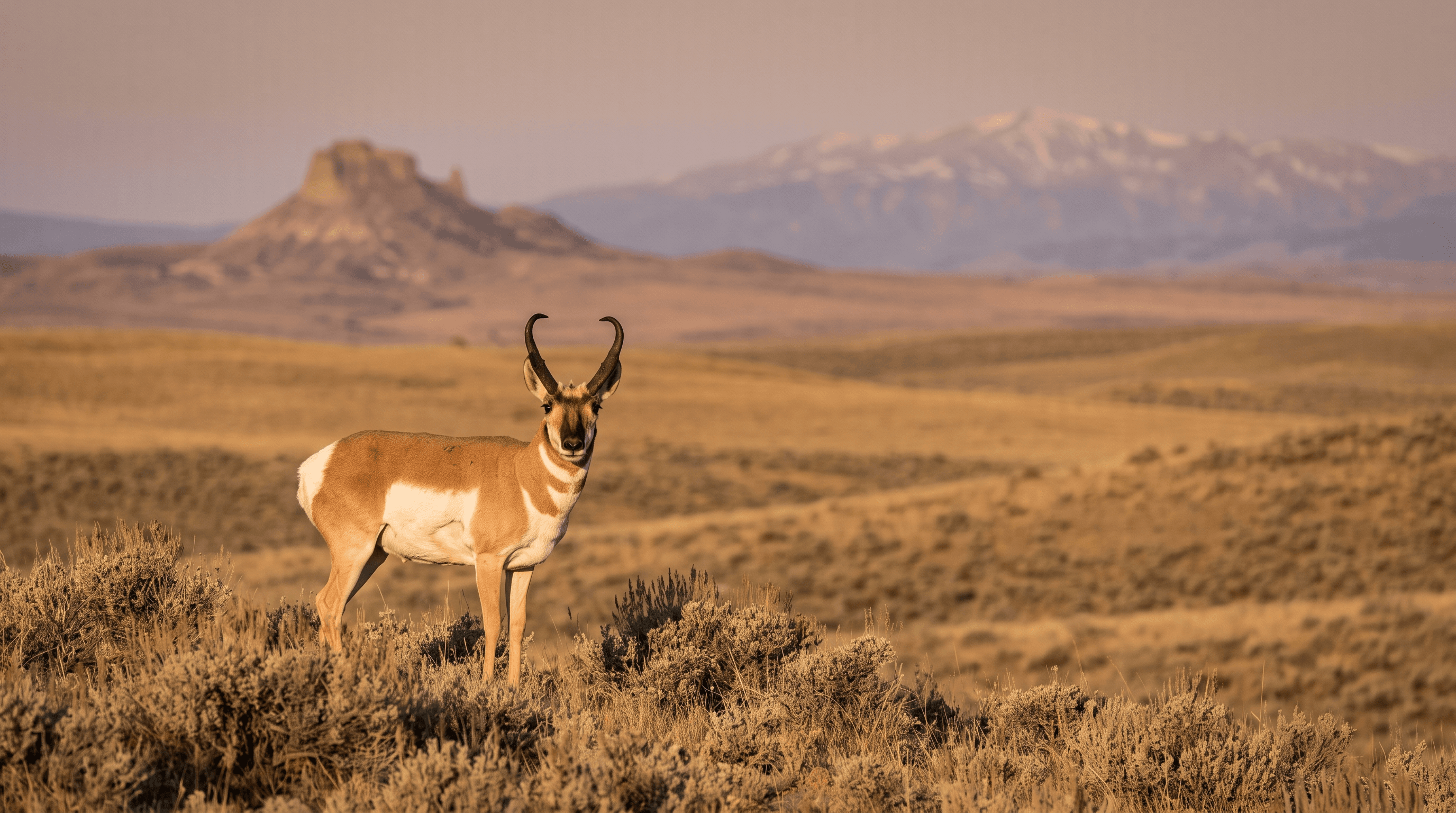
Pronghorn carry the largest eyes, relative to body size, of any big game animal on the continent, and they sweep a visual field close to 300 degrees. You can know that going in and still not believe it until your first stalk falls apart — a buck at 500 yards reads your movement the way you'd read a neon sign, decides you're a problem, and leaves the county at a pace that looks like a rendering error. Every instinct you built on deer and elk works against you out here. The sooner you accept that antelope hunting is its own game, the sooner you start closing on bucks instead of educating them.
Put in for Wyoming first
If this is your first do-it-yourself pronghorn hunt, Wyoming is the answer. The state holds roughly 480,000 antelope — more pronghorn than people — spread across sagebrush that runs to the horizon in any direction you'd care to drive. Draw odds in most units sit around 50 to 70 percent. Over-the-counter archery tags let you skip the lottery entirely. Public BLM ground is everywhere, and rifle hunters fill tags at better than 85 percent most years. That isn't the guided rate. That's the general tag. Get your application in before the late-April deadline, because the learning curve on this animal is steep enough without waiting a decade to start climbing it.
Montana is the runner-up: draw-only, moderate odds, and eastern prairie country that stretches past the horizon with fewer trucks on it. Colorado sells over-the-counter archery tags if you want to hunt this fall no matter what the draw gods say. Nevada and Arizona are, for practical purposes, trophy programs reserved for hunters sitting on fifteen-plus preference points. If the goal is learning antelope and filling a freezer, none of them beat a Wyoming rifle tag.
Glass more than you walk
The whole hunt runs on one loop. Find a rise with long sight lines. Set up a tripod. Glass until you turn up a buck worth chasing. Then spend the next two to four hours trying to close inside shooting range without being seen. Repeat until something goes right.
That loop is why optics matter more on pronghorn than on anything else in western hunting. Judging a buck at 600 yards in flat afternoon light — mass against tine length, prong size, the depth of that rear curve — through mid-grade 8x42 binoculars is closer to gambling than judging. A quality 10x50 is the sweet spot for this country: enough magnification to read detail across open ground, and the bigger objective pulls in light during the first hour of the morning, which is exactly when bucks are on their feet. Buy the best glass you can afford and carry it in a chest harness, not a pack. You'll be behind it for most of every day.
A spotting scope earns its weight once you're judging animals past 400 yards. The difference between "that looks like a decent buck" and "that buck is worth a four-hour crawl" usually takes 30 to 40 power to settle. If you chase antelope a few weekends a season, a mid-tier 20-60x85 does the job honestly; the flagship glass is for people who make this their whole fall.
Wait until the stalk exists
Most failed stalks were dead before the first step. The classic mistake is committing on a buck that's feeding in flat, open ground with nothing useful between you and him. You start walking. He pins you at 600 yards. Now he has watched you for ten minutes, and he will not let you back inside 400 for the rest of the afternoon.
The fix is patience, not fieldcraft. Pronghorn travel constantly — feeding, checking does, shifting toward bedding ground, patrolling the edges of their territory. A buck standing in the wide open right now may feed into a draw within the hour and hand you 400 yards of covered approach. The hunters who kill antelope every season are the ones willing to watch an animal for two hours before deciding whether a stalk exists at all. Rushing is the most common first-hunt mistake, and it stays common because the buck is right there and your legs work.
What counts as cover in antelope country is humbler than anything you'd call cover back home:
- Dry creek bottoms and washes deep enough to walk or crawl below his sightline
- Shallow draws that shave a few feet off your profile
- Rolling sagebrush ridges that break your outline against the sky
- Fence lines with a strip of tall grass grown up along the wire
Ground that reads like a pool table from the road almost always hides two-foot drops and low sage thickets that will float you below a pronghorn's vision — if you stay low and move deliberately. Expect real time on your elbows. The belly crawl has its reputation for a reason.
Wind matters, but it runs second to movement. Pronghorn live by their eyes. What burns stalks is motion while the buck's head is up. The rhythm is simple to describe and hard to hold: move when he feeds, freeze when he lifts his head, and wait him out. That is most of the job, and there's no shortcut through it.
Shot distance, and the four days that change the rules
Most pronghorn are killed between 150 and 300 yards. Practice to 400 before you leave home — not because you should be stretching that far on your first trip, but because a week of season disappears fast and some opportunities never come closer. First-timers who hold out for a picture-book 150-yard setup have a way of driving home with a tag still in the console. A mature buck standing broadside at 270 in calm conditions, off a solid rest, is a high-percentage shot. Take it. Pronghorn hunting recalibrates your idea of a gift as the week wears on.
And if you're hunting the last two weeks of September, pack a decoy. The rut turns bucks territorial, and a decoy paired with a chuckle call or a buck snort will pull them across distances that look unworkable through the binoculars. The peak lasts maybe three or four days depending on the year and the country — but inside that narrow window, the wariest animal on the plains briefly volunteers to come to you.
The meat clock runs fast
September antelope seasons are hot. Eighty-degree afternoons are normal in Wyoming during early rifle, and pronghorn run a higher body temperature than deer or elk, so the meat turns faster than late-season whitetail experience would suggest — back home, cold air does half the work for you. Out here nothing does.
Field dress immediately after the shot. Quarter and bag within an hour of the kill — one hour, not two. Keep hair off the meat; even a little contact adds an off flavor to an animal whose meat is already distinctive, and clean-handled pronghorn is genuinely fine eating. Use breathable game bags, never plastic, and get quarters on ice the same day. Bring the coolers you suspect are too big. They aren't.
Plan to fail, then don't
Pronghorn hunting is harder than it reads on paper. The animal's vision borders on unfair, and the terrain strips away nearly everything cover normally gives you. Most hunters burn several stalks before their first kill, and that isn't failure — that's the apprenticeship. Go in expecting it, and when the right buck feeds into the right draw on day four, you'll know exactly what to do.
There's also an honest case for hiring out the learning curve. If you get one week a year for a western hunt and this is your first, a guide who lives in antelope country brings the two things a DIY hunter spends seasons building: knowing which ground actually holds bucks, and knowing which stalks are worth starting. Antelope makes a friendly first guided western hunt, too — the success rates are real and the country is kind to a flatlander's lungs. Independent guides and outfitters run their own bookings through timberandtackle.guide, so when you book one, you're dealing directly with the person who'll be behind the spotting scope beside you.