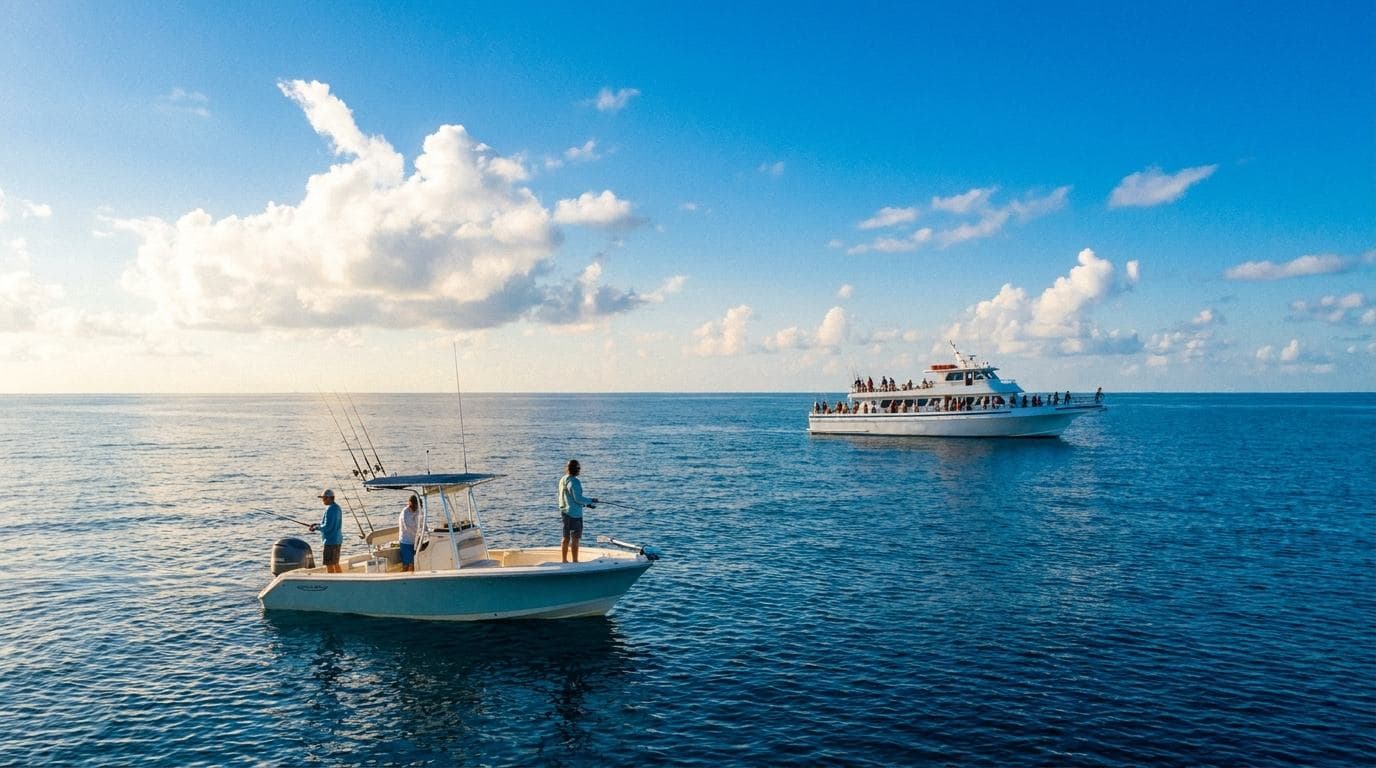
Two Very Different Trips, Both Called a Charter
Search for a fishing charter in any coastal market and two very different products show up under the same word. A private charter and a shared charter aren't variations on the same thing — they're different experiences, different social dynamics, different cost math, and different fits depending on who you are and what you want from the day. Know which one you're booking before you show up at the marina.
What a Private Charter Is
A private charter means the whole boat, the captain, and the mate — if there is one — are yours for the day. No strangers. Nobody else's pace to accommodate. No waiting for another angler to reel in before you can change positions. The trip serves your group from the moment you leave the dock to the moment you're back.
Private charters run on smaller boats: a flats skiff for one to three people, an inshore bay boat for two to four, an offshore center console for four to six. When the fishing says move, the captain moves — there aren't a dozen other rods to factor in. When you want to try a different technique, you have that conversation directly. The day gets built around your group.
What a Shared Charter Is
A shared charter — a walk-on trip, a head boat, a party boat, depending on the size of the vessel — means you're buying one spot on a boat that's also selling spots to anglers you don't know. You pay per person. A smaller shared boat might carry 6 to 12 anglers; a full party boat running off a public pier can carry 20 to 50.
Everyone fishes the same water at the same time. The captain picks the species, the spots, and the schedule based on what works for the whole boat. You don't customize the trip — you join one. Shared charters run fixed departure times, work established routes, and are built to put a lot of people on fish efficiently. The crew is managing many rods at once, at a pace that keeps the most people productive.
One red flag worth naming, because it burns first-timers every season: a shared-trip listing that won't tell you the passenger count. If the page says "join us for a great day on the water" and nowhere says how many rods that means, assume the boat fishes full — and full might be forty people shoulder to shoulder on a rail. The honest operations put the number right on the listing. When a listing hides the one fact that most changes your day, treat that as the answer and book somewhere that publishes it.
The Cost Math: Per Person Is What Matters
The sticker price on a private charter is higher than a shared trip. Sure. But the comparison that matters is cost per person, and the gap is smaller than it looks.
Shared inshore trips in most U.S. coastal markets run $75 to $125 per person for a half day. A private inshore charter on the same water for the same hours might be $400 to $600 total — at two people, that's $200 to $300 each, genuinely more expensive. At three or four people, the private trip's per-head price compresses toward the shared price, and you've got the whole boat.
Offshore, the swing is bigger. Run the whole thing once, tips included, and watch what happens. Take a group of four choosing between $150-per-head shared offshore spots and a $1,600 private boat:
- Shared: 4 × $150 = $600, plus tips around $30 a head = $720 total, $180 each
- Private: $1,600 for the boat, plus a 20% crew tip of $320 = $1,920 total, $480 each
So the real gap for that group is $300 a person — not nothing, but a long way from the sticker's $1,600-versus-$150 shock. Add a fifth and sixth angler to the private boat and it drops to $320 a head, close enough that the whole-boat trip usually wins on value alone. The practical rule: shared trips make the most sense for solo anglers or pairs watching costs. Private gets cost-competitive at three to four people, and it's the clear value winner at five or more.
Flexibility and Control
On a private charter, you get a say in how the day runs. Want redfish instead of flounder? Say so on the booking call. Want to throw fly tackle for the first hour? A good captain will work with that. Want to move after an hour of slow fishing? The captain can make that call fast, because moving only affects your group.
On a shared charter, the captain is optimizing for the boat, not for you. That means reliable species, spots that keep most people catching, and a trip that runs the way it runs every day. A well-run shared charter is genuinely good fishing. But it isn't built around your preferences, and knowing that going in shapes how you experience it.
Instruction and Attention
For beginners, and for anglers who actually want to get better, this is where the two formats split hardest.
On a private charter with two to four anglers, the captain and mate are watching your group and nothing else. They'll catch your casting mistakes and fix them. They'll explain why they picked this depth, what the current's doing, how to read the water. The coaching is direct and constant, and beginners improve fast because every mistake gets immediate, specific feedback.
On a shared trip, one mate might be running a dozen lines. They'll bait your hook, net your fish, and answer questions — but sustained one-on-one coaching isn't realistic. Beginners can still have a productive, enjoyable day on a shared boat. Just go in knowing the attention comes in passes, not in a steady stream.
The Social Experience
Some anglers genuinely like the shared-boat atmosphere. You're on the water with other people who fish, the energy during a hot bite is communal, and meeting strangers over a rail can be part of the fun. For a solo traveler, that's something a private trip can't offer.
Others book a trip precisely to be on the water with their own people — a family outing, a trip with old friends, a bachelor party, a work day on the water. For those groups, strangers on the boat work directly against the point of the trip. When the group dynamic is the point, private is the obvious call.
Seasickness: A Practical Note
On any offshore or open-water trip, seasickness is a real consideration, especially for first-timers. It matters more on shared charters because you've got less control over the day. On a private boat, you can ask the captain to work calmer water, adjust the route, or head in early if someone's struggling. A shared boat runs its route regardless of how any one passenger is feeling.
If anyone in your group is prone to motion sickness, take a non-drowsy over-the-counter remedy — Bonine or non-drowsy Dramamine — the night before and again the morning of. Eat light. Stay hydrated. Skip the alcohol on board. Ride near the center of the vessel, where the motion is smallest. On a private charter, tell the captain before the trip — experienced captains know how to route around rough water when they're given the choice.
Which One Is Right for You
- Book a shared charter if: you're a solo angler or a pair watching costs, you like the social side of fishing next to strangers, you want an affordable first look at a fishery without committing to a full private trip, or you're flexible on species and just want a day on the water with an experienced crew.
- Book a private charter if: your group is three or more, you want a say in target species or technique, you've got beginners who'll benefit from real coaching, you're marking an occasion and want the boat to yourselves, or you've got a specific fishing goal and want the captain working toward it with you.
Either way, the biggest variable in your trip isn't the format — it's the captain. A sharp, communicative guide on a shared trip beats an indifferent one on a private boat every time. Read recent reviews. Ask what species are realistic for the season and the water. Confirm the captain actually knows the specific fishery. The boat format is secondary to who's driving it and how well they run their operation.
Still weighing the options? Browse the rest of the guides library for more on picking a captain, tipping, and what your first charter actually looks like — then book directly with the captain who fits your trip.