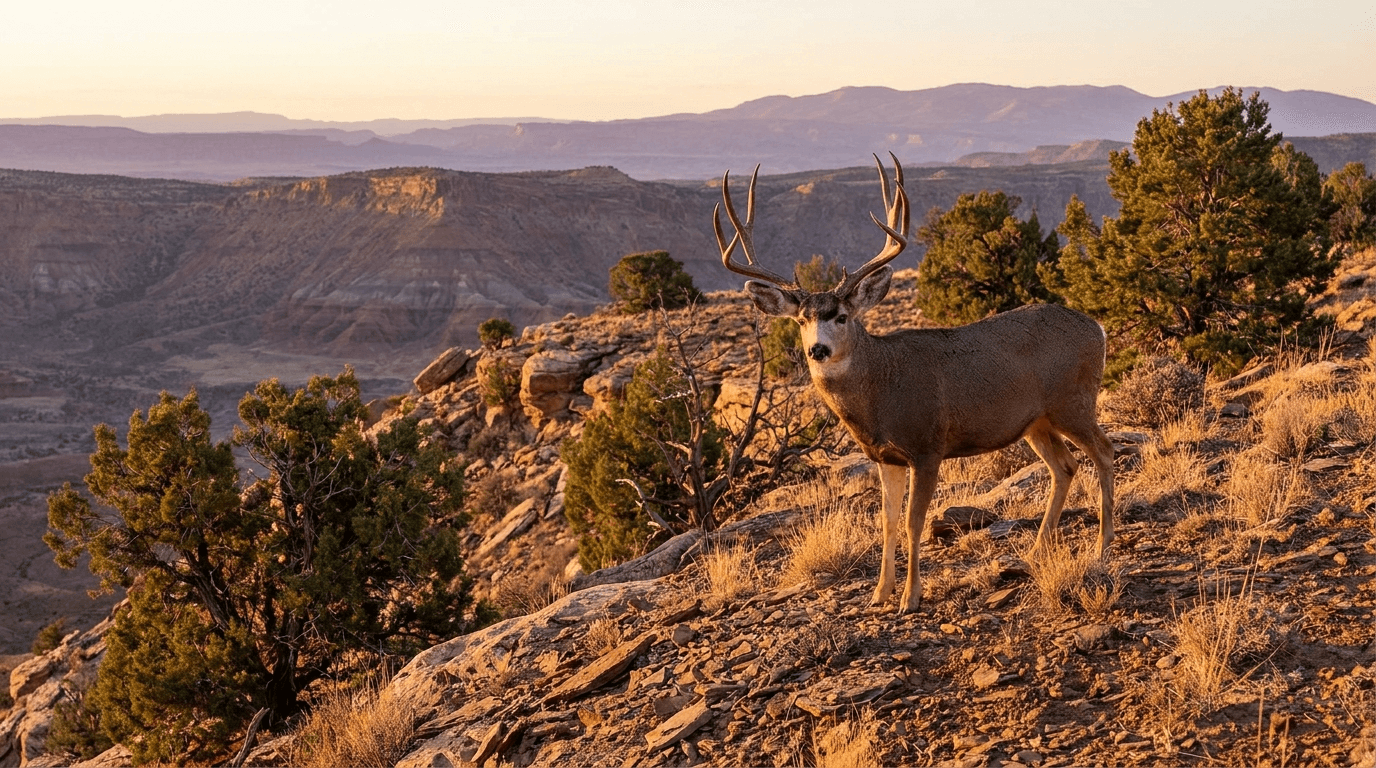
A mule deer stalk usually fails at the beginning, not the end. The buck gets glassed up, a rough direction gets picked, and the hunter starts walking, planning on the move. Half an hour later he crests a ridge into swirling wind, the bed is empty, and the best morning of the trip is gone.
The plan has to be built from your glassing position, at distance, while the deer is still in the glass. The moment you stand up, you're committed. Terrain closes around you, the buck drops out of view, and every decision after that runs on memory. Getting within range isn't what beats most hunters. Getting there without being winded is.
Sit More Than You Walk
Whitetail hunters coming west make the same mistake almost every time: they want to cover ground. They're used to hiking to a stand or slipping through timber, so big open country makes them feel like they should be moving. Mule deer country punishes that instinct.
The hunters who kill mature bucks year after year sit more than they walk. A morning spent picking apart one canyon from a ridge will outproduce four miles of boots on talus, and it does it without educating a single deer. You're hunting with your eyes out here. The binoculars are the primary weapon; the rifle or bow only matters after you've found a buck worth chasing and watched him long enough to know what he's going to do next.
That changes how you build a day. Pace stops mattering. Where you sit, and how well you can see from there, matters a great deal.
Build a Real Glassing System
Pick a vantage point that covers as much country as possible without putting your outline on the skyline. Saddles work. So do knobs above a canyon, or the back side of a ridge where you can peek over the top. You want somewhere you can settle in, get the glass stable, and work the country methodically instead of craning around a rock.
Then grid it. Divide the terrain into sections and give each one real time, not a sweep. Thirty seconds on a patch of brush or shadow is a minimum. A bedded buck doesn't announce himself; he shows you an antler tip in a juniper shadow, or one ear that flicks when the flies get bad. If you're scanning, you'll slide right past him.
This is the stage where glass quality earns its price. Two hours picking apart a canyon at 600 yards asks a lot of your optics and your eyes both. A good 10x or 12x binocular on a stable rest will find deer that cheaper glass simply never shows you, and a spotting scope earns its weight twice: once for judging whether the buck is worth a stalk, and again for studying the route before you take it. Look for drainages that run toward him like hallways, benches that keep you at his elevation instead of below it, rock that breaks up your outline. Find the route in the scope, not on the mountain.
Where the Deer Are, Hour by Hour
Mule deer move on temperature and thermals more than on a clock, but the daily pattern is reliable once you understand what drives it.
- First light: Bucks feed through the dark and into early morning on open slopes, drainage heads, and flats near ridgelines. They're on their feet and visible, which makes them easy to find and hard to stalk. The window closes as they drift toward shade.
- Mid-morning: By 9 or 10 most deer are bedded, and they choose those beds well. A view in front, wind at their backs. A rock outcrop on a north slope, the junction of two ridges, anywhere that lets them see and smell trouble coming from different directions.
- Midday: This is the window most hunters waste. Between roughly 11:30 and 2:30 the thermals are at their steadiest. The sun has fully heated the ground, air rises at a consistent rate, and for once you can trust what your wind indicator tells you. The buck has been in his bed for hours and isn't going anywhere soon. A stationary deer in stable air is the best stalking setup the day will hand you, especially with a bow.
- Evening: Deer get up an hour or two before dark and work back toward feed. By then the thermals are falling, draining downslope into the valleys and bottoms. Pick your evening glassing position above that airflow, not inside it.
Notice what that pattern means in practice: a lot of hunters are walking back to camp for lunch at the exact hour the mountain finally gives them honest wind and a pinned-down buck. Stay out.
Plan the Stalk Before You Stand Up
Here's the question most hunters never ask: where will the deer be when you arrive?
A stalk in open country takes 30 to 60 minutes depending on the ground. If the buck is feeding when you leave the glass, he'll drift the whole time you're in the drainage without eyes on him. If he's bedded, he'll stay put — until he doesn't. Either way, you're walking toward where he was, not where he is, and the plan has to account for that.
Before you leave the glassing position, do three things.
First, pick a landmark. Not "over by that ridge" — something exact, like ten yards left of the lone juniper below the tan rock band. When you lose visual contact on the approach, and you will, that landmark is what keeps the stalk honest.
Second, map the route in segments. Name the first piece of cover you'll move behind, then the next one, then the spot where you'll close the final distance. Drainages are your best asset here. They hide you, they break your silhouette, and they tend to channel air in a direction you can predict.
Third, trace your scent. Figure out where it's going relative to the buck right now, then think about what changes as you move. At what point does the route turn from downwind to crosswind? Is there a draw that could funnel air somewhere new once you're down inside it? Those transition points are where stalks come apart, and you want to know about them while you can still plan around them.
What Thermals Do Mid-Stalk
You check the wind at your glassing rock. It's in your face, and you feel good about it. Twenty minutes later, halfway down a draw, the air is swirling and you have no idea where your scent is going. Nothing malfunctioned; you just walked into different air.
Small terrain features create micro-thermals that ignore the overall drainage pattern. A south-facing rock wall catches sun early and pushes warm air outward. A shaded draw holds the cold from overnight, releases it upward through mid-morning, then reverses in the afternoon heat. None of it is visible from a ridge a quarter mile away, which is exactly why the wind check you did at the start doesn't count as a wind plan.
The habit that fixes this is simple and non-negotiable: check your wind constantly on the approach. Every few minutes, and always before you cross a ridge or step out of cover. Milkweed floss works. So does an unscented powder bottle. It weighs nothing and it settles arguments the back of your neck can't.
When the air does something you didn't plan for, stop and wait. A bedded buck in stable midday conditions will hold that bed for hours. You can afford five quiet minutes to let the air sort itself out. What you can't afford is pushing forward while your scent runs ahead of you.
The Last 80 Yards
Most stalks that survive the approach die right here. You're close, there's antler visible through the brush, and everything in you wants to hurry — to close the gap before something changes.
Slow down instead.
The final stretch is one step at a time, feeling each footfall before you commit weight to it. Your pack should be cinched tight enough that nothing shifts or rattles. Your clothing should move quietly through sage and dry grass; this is where a soft fabric pays for itself and a crinkly shell costs you a buck.
It helps to know how mule deer handle alarm, because it's different from whitetail. A muley that catches movement usually doesn't bolt. He stops, stares, and tries to work out what he saw before he commits to a decision. When that head comes up, freeze — mid-step if that's where you are. Hold it. Most of the time he'll stare for 30 to 60 seconds, decide nothing's there, and drop his head again. Move only after it drops. One rushed step at 70 yards is how hunters undo the 400 they executed perfectly.
Gear That Earns Its Place
The list is shorter than the gear articles suggest.
- Optics: Binoculars on your chest all day, every day, in a harness so they're wearable rather than packable. A spotting scope in the pack for judging bucks and picking apart routes. If you're deciding where the money goes on this kind of hunt, it goes here.
- A pack with a frame, or one that accepts a frame insert. A frameless daypack handles the approach fine, but when you're four miles from the trailhead with 70 pounds of meat and hide, you need structure under the load.
- Boots that are quiet, grippy on rock, and broken in before the hunt, not during it. Blisters end more stalks than bad thermals do.
- A wind indicator, used every few minutes. Not once at the truck.
Everything else is comfort. Those four things are the hunt.
When a Guide Makes Sense
All of this is learnable on your own — but the tuition is paid in blown stalks, and the semesters are hunting seasons. A good mule deer guide compresses years of that learning into a week. He already knows which canyons hold bucks in October versus November, he's watched the thermals move on those exact slopes through a hundred middays, and he'll make the freeze-or-move call at 80 yards while your heart is still hammering. If you've drawn a tag in country you've never seen, or you get one western week a year and can't spend it on the learning curve, hunting with a guide is often the honest play. Independent guides and outfitters run their own books at timberandtackle.guide — you book directly with the person who knows the country, and the trip price goes to them.