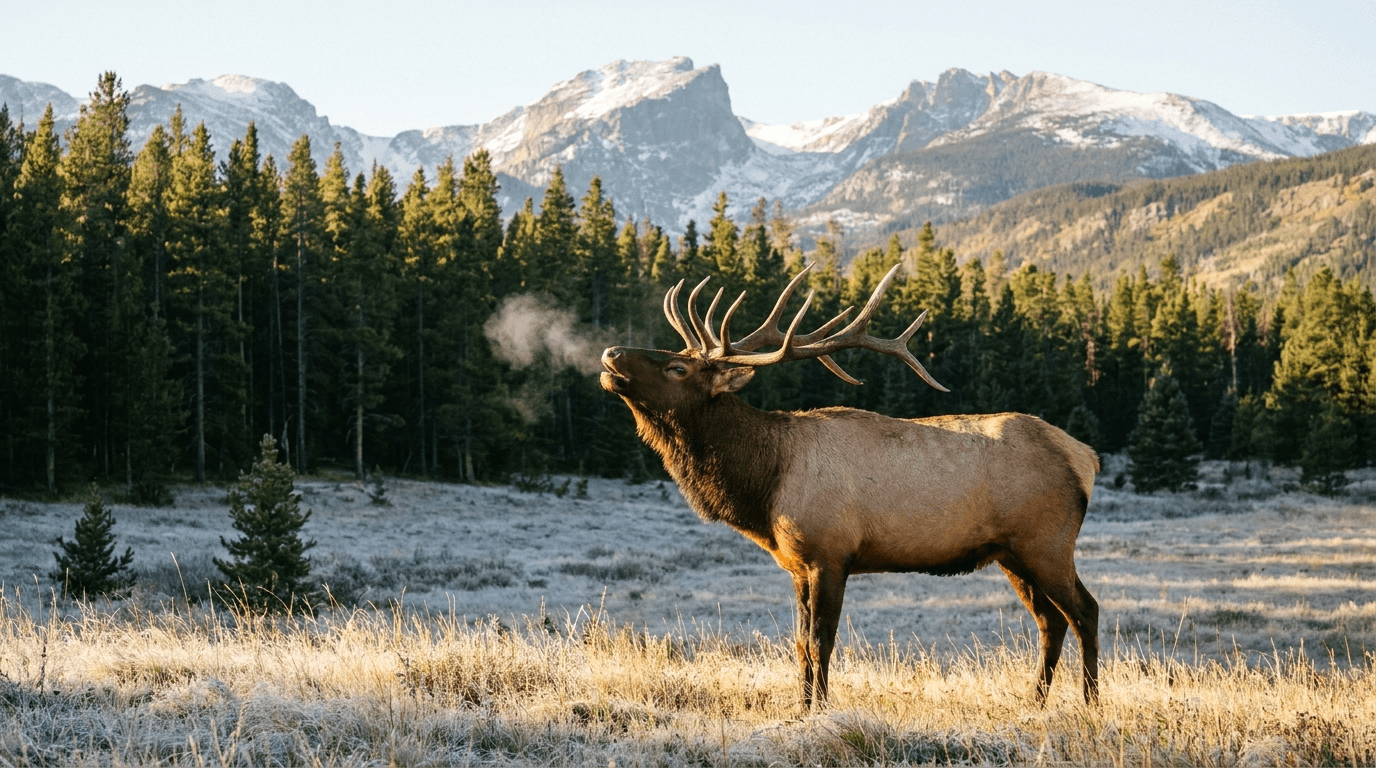
First light, September 8, a dark-timber saddle. A bull screams from the drainage below you — close, maybe 250 yards. You bugle back. He answers. You bugle harder. Silence. Five minutes later you hear timber cracking as he walks the other way.
That exchange plays out thousands of times every September, and the mistake inside it is the most natural one in elk hunting: answering every bugle with a bugle. The bull didn't spook. He wasn't call-shy. He sized you up from a quarter mile off, decided you sounded like a fight he didn't need, and took his cows elsewhere.
Here's the thing most bowhunters take years to accept. Bugling locates bulls and challenges bulls. It almost never closes them. Once you've found your elk, cow calls and silence do the finishing work.
The rut phase decides everything
Archery season runs roughly September 1 through mid-October across most western states, and that window holds two different animals wearing the same hide.
Early September (roughly the 1st through the 14th): the rut hasn't caught fire yet. In a herd of a hundred cows, maybe one or two are in estrus. Most herd bulls haven't gathered cows. They're feeding, saving their bodies for what's coming, and suspicious of everything. An aggressive bugle sequence in the first week of September is one of the fastest ways to push a mature bull off your drainage for three days.
Peak rut (about the 15th through the 25th, spiking near the equinox): now the herd bulls are locked onto cows, screaming constantly, and willing to do genuinely stupid things. Satellite bulls — mature elk orbiting the herds without cows of their own — are frustrated and aggressive. Hard calling starts paying off because the bulls are already primed for it.
The calls themselves barely change between those windows. The frequency and the aggression change completely. Know which week you're standing in before you make a sound.
What the bull is actually telling you
A bugle isn't noise. It has a job, and if you can read the job, you know how to answer.
- Location bugle: short, almost tentative. A bull asking whether anyone's out there. Safe to answer — no threat in it and none needed back.
- Challenge bugle: chuckles on the end, guttural grunts. That's an angry bull announcing himself, and he'll come to aggressive calling because he's already in that headspace.
- Herd bull dominance bugle: long, full, powerful. He owns the mountain and says so. Challenging him from 400 yards mostly tells him you're big and stupid. The better play is soft cow calls with some raking mixed in — the suggestion that one of his cows is flirting with a rival he hasn't located yet.
- Glunking: deep, rhythmic grunts from a bull working close to his cows. If you can hear it, he's inside 100 yards and focused on the herd. Stop bugling entirely. Go to soft mews.
You're bugling too much
Most archery elk hunters overcall, and not because the tactic is wrong. Because it feels incredible. A bull screams at you across a canyon and every nerve you have says scream back.
Resist it. Every bugle hands the bull your exact position. Once he knows where you are, he has no reason to move — he can yell at you all morning from wherever he's comfortable. You've given him a map and thrown away the one advantage you had, which was his uncertainty.
The sequence that works: one locating bugle, maybe two, then a hard switch to cow calls. Let him wonder where the cows went while he thinks he knows where the bull is. That tension — cows somewhere ahead, a rival somewhere behind — is what actually moves elk.
In early September, three bugles an hour is a reasonable ceiling. During peak rut you can push well past it. But the instinct to match every call with a call is wrong in both windows.
Wind first, calling second
No sequence survives a blown setup. Nearly every bull that commits will circle downwind before he shows himself, so build the setup around that fact.
Morning thermals are the predictable part: cool air pulls downhill until the slopes heat up. Midday goes swirly and unreliable. Afternoon thermals lift uphill. A bull circling downwind at 8 a.m. ends up in a different spot than the same bull at 2 p.m., and your shooting lanes need to account for the difference.
The standard two-man setup puts the shooter 30 to 50 yards upwind of the caller, lanes open toward the side the bull will circle from. He comes to wind the caller and walks broadside past the shooter on the way.
Three pieces of terrain worth building a morning around:
- Saddles. The low points between ridges. Elk funnel through them and rutting bulls bugle in them. During peak rut they go to the top of the list.
- Benches. Flats cut into steep timbered hillsides where elk bed. A bench carrying fresh droppings, rubs, and beds is a setup, not a waypoint.
- Wallows. The early-September wild card. Dark churned mud, torn banks, the ammonia smell of elk urine — fresh wallow sign marks one of the best ambushes in the woods, most active in the first two hours of light.
When he hangs up
A bull that answers and holds his ground isn't finished. He's processing. Your job is to feed him new information.
With a partner, the play is the fading cow. The shooter holds the original position. The caller backs off 50 to 75 yards, mewing softly on the move, painting a cow walking away. A herd bull that hears cows drifting off with a rival in the neighborhood will often follow — straight through where the calling used to be, right past the waiting shooter.
Alone, go quiet for five or ten minutes, then drop a single soft mew. No volume, no edge. Some hung-up bulls just need the pressure to come off. If that fails, close the distance yourself — cut 40 or 50 yards and call again. Either you bump him, which ends the stalemate and saves you an hour, or the new geometry gives you a shot. Trading bugles with a bull yo-yoing at 200 yards is just spending daylight.
Learn the diaphragm, endure the two bad weeks
A diaphragm call in a practiced mouth sounds more like an elk than anything else you can carry, and it leaves both hands on the bow when the moment comes. It also defeats most people. They buy one, gag on it ten times, and it goes in a drawer.
Buy a three-pack with different cuts. Keep one in your mouth on the drive to work. Cow mews first, then the transition into a bugle. It will sound terrible for two weeks, and then something clicks and it doesn't.
Pair it with a grunt tube for depth and reach. The diaphragm alone runs thin at distance, the tube alone sounds hollow, and together they're what nearly every serious archery elk caller ends up carrying. Round out the kit with a 10x or 12x binocular you trust — most of elk hunting is finding elk, and glass that picks tines out of a timber edge at first light earns its weight before the calling ever starts.
One hard note on regulations: electronic calls are illegal for elk in most western archery states, Colorado, Idaho, and Montana among them. Check the current regs wherever you hunt. Most hunters who've done this a long time wouldn't trade the diaphragm anyway.
Read the bull, not the script
There is no sequence that kills elk. The hunters who close year after year read the specific bull in front of them and answer what he's doing, not what a video said he'd do. When he's hot and coming, get quiet and get out of the way. When he hangs up, change something. When he goes silent, don't fill the silence with more noise.
And if this is your first September in the mountains — or your first with a bow — be honest with yourself about the learning curve. Reading rut phases, running thermals, and calling with a shooter in position is judgment that takes seasons to build alone and days to absorb standing next to someone who lives it. A guided archery elk hunt puts a caller behind you who has heard ten thousand bugles and knows which kind this one is. Independent guides and outfitters run their own books at timberandtackle.guide — when you're ready to hunt September with someone who already speaks the language, that's a good place to start.
The call creates the encounter. The rest is hunting.