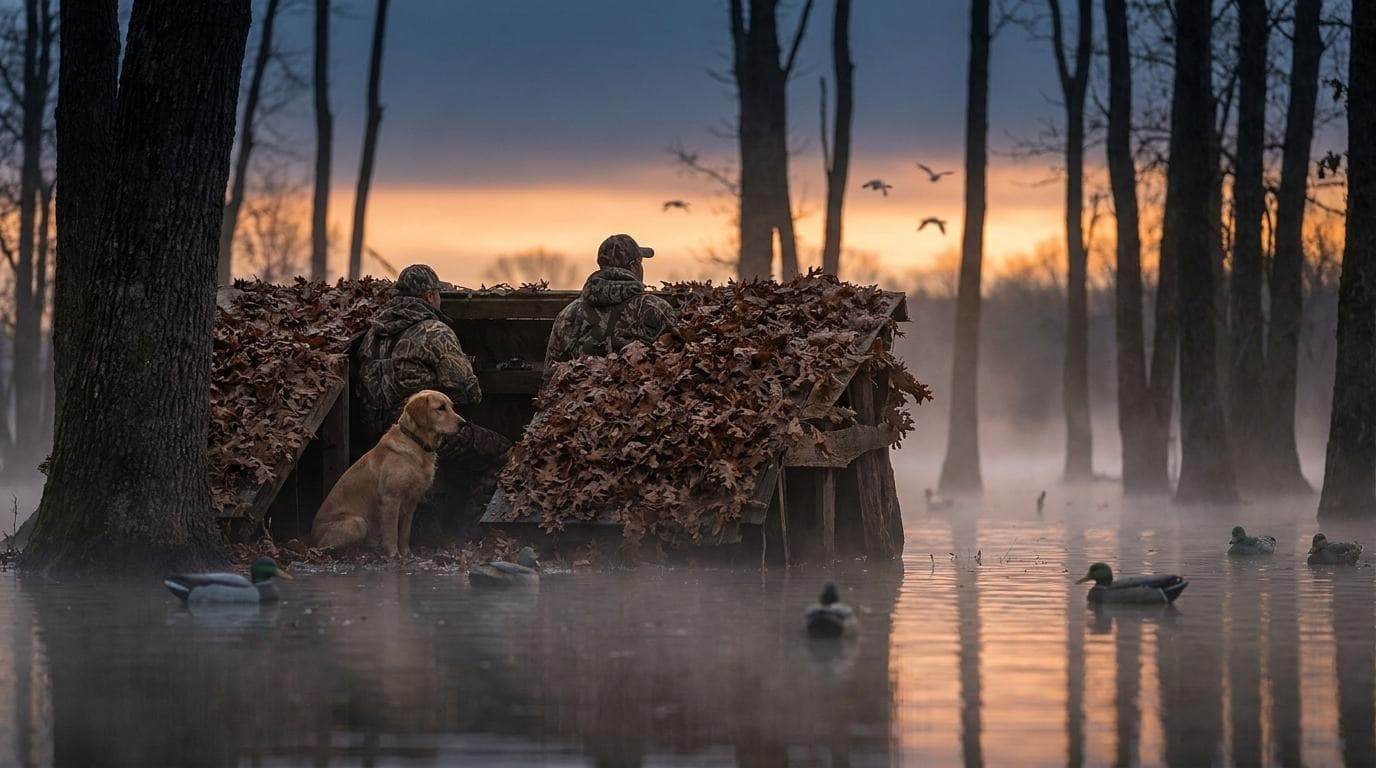
Most waterfowl outfitters undercharge, and they do it for the same reason most service businesses undercharge: they built their rate around what feels comfortable rather than what actually covers the season's overhead and leaves a real margin. A $250-per-gun day hunt sounds reasonable until you run the math on blind leases, decoy inventories, fuel, guide labor, and the three hunts a month you'll cancel due to weather.
Here's how to set waterfowl rates that reflect your actual costs, what the market charges across major flyways, how to structure deposits that protect your calendar, and the add-ons that make the difference between a good season and a great one.
What the market actually charges
Day hunt rates across the U.S. waterfowl market run roughly $225–$350 per person per morning for guided hunts without lodging. The spread is wide because location, land access, and the species mix all move the number.
- Missouri and Arkansas flooded-timber operations: $225–$350 per gun per morning
- Opening weekend and early season: $325–$400 per gun, with minimums of three guns per blind
- Weekday vs. weekend premium: many outfitters charge $50–$75 more per gun on Saturdays; $250 per gun weekday vs. $300 per gun weekend is common
- Solo or small-party surcharge: some operations charge $350–$450 per person for a one- or two-person booking
- All-inclusive packages (three days and three nights, lodging, meals, guided hunting, bird processing): $1,200–$1,800 per person depending on region and species
- Lodge operations with three meals and full guide service: up to $625 per person per day
- Snow goose conservation season: $300–$350 per person daily; all-inclusive conservation hunts with unlimited shooting and a lodge night closer to $550
The per-gun minimum isn't optional for most operations. If your blind comfortably holds four hunters and you need $900 per day to cover costs before profit, you can price at $300 per gun with a three-gun minimum or $225 per gun with a four-hunter requirement. The minimum protects you from the two-hunter booking that leaves a $450 gap in your day.
Your overhead floor
Before you set a rate, calculate what it costs to run one morning hunt. Most outfitters skip this step and price from what competitors charge — which means you're anchoring to whatever someone else decided, not to your actual business.
A realistic cost breakdown for a single guided duck morning:
- Blind or land lease: A seasonal blind lease in Missouri runs $5,000–$10,000 for the season, plus a share of pump electricity that can add $1,000–$3,000 per blind annually. Spread across 60 guided mornings, that's $100–$215 per morning in land and water costs alone.
- Decoys: A full spread of 8–10 dozen decoys represents a $2,000–$5,000 upfront investment. Depreciated over three to four seasons, you're adding $20–$40 per morning.
- Blinds, calls, and gear: Quality layout blinds run $150–$250 each; depreciated, add $15–$25 per morning.
- Guide labor: If you hire a guide, a waterfowl guide day rate runs $150–$250. If you're guiding yourself, your time has a floor — what else would you earn in those hours?
- Fuel and transportation: Scouting runs before season plus daily boat or ATV fuel add $20–$60 per morning.
- Retriever costs: A well-trained retriever carries real ongoing cost — kennel, food, vet care, and training run $3,000–$6,000 per year. Across 60 guided days, that's $50–$100 per morning.
Total overhead per morning: realistically $350–$600 before your own labor. If you're charging $225 per gun and running three hunters, you're bringing in $675 — barely $75–$325 above costs before you've paid yourself. Run a few weather cancellations and you've worked a week for nothing.
That math is the argument for a $300-plus rate. Not the market comparison.
Building your rate card
A rate card that accounts for seasonal variance and party-size flexibility does three things: it protects your cost floor on slow booking periods, lets you capture the premium on high-demand dates, and gives clients clear options rather than a single take-it-or-leave-it price.
A structure that works for most operations:
- Day hunt (no lodging): $275–$350 per gun weekday / $325–$400 per gun weekend, three-gun minimum per blind
- Opening weekend premium: Add $50–$100 per gun above your standard weekend rate; hunters booking prime opening dates plan for the premium and fill your calendar months out
- All-inclusive three-day package: $1,400–$1,800 per person; include lodging, meals, guide service, and bird processing — price the bundle $50–$100 per person above the same items priced separately
- Snow goose conservation season: $300–$350 per person daily, or $500–$550 for all-inclusive conservation hunts with unlimited shooting and a lodge night
Opening weekend is where most waterfowl outfitters leave serious money. Hunters plan it months out; your calendar fills before standard-season dates do. Price it from the start with a meaningful premium — $400 per gun or more for a prime flooded-timber blind in Arkansas or Missouri isn't unreasonable, and hunters who book in August already know what they're signing up for.
Deposit structure
Waterfowl has a cancellation challenge that whitetail and turkey seasons don't share at the same scale: flyway conditions, migration timing, and drought all affect whether a given week produces birds. Hunters understand this — which is why deposits rather than full prepayment are the standard.
The deposit structure most waterfowl operations use:
- 50% non-refundable deposit due at booking
- Remaining 50% due 14–30 days before the hunt date
- Client cancellations 60 or more days out: deposit applied toward a future hunt date (some outfitters keep it outright; either approach is common)
- Cancellations inside 30 days: no refund, no transfer; the full amount is owed
One important distinction worth putting in writing before you need it: weather and migration conditions aren't a client cancellation. If you call off a hunt because the flyway hasn't moved and the client has already traveled, you owe them a rescheduled hunt or a refund. Make this explicit in your booking contract. Hunters who book a $1,500 three-day package will ask — and having a clear written answer builds the relationship rather than ending it.
Add-ons that actually sell
A few additions sell well to waterfowl hunters and are worth listing directly on your booking page:
- Bird processing: $15–$25 per bird for cleaning and packaging. Most out-of-state hunters can't transport unprocessed birds home, so they'll pay it without hesitation. If you have a processing relationship in place, this is straightforward margin.
- Lodging referral (for day-hunt operations): Point clients to vetted local accommodations. Even without a formal referral arrangement, clients who know where to stay book with more confidence and fewer pre-trip questions.
- Retriever fee: If your trained dog is a genuine part of the hunt — marking, retrieving, working the spread — a $50–$75 guide dog fee per party per morning is reasonable. Hunters who've hunted behind a well-trained retriever understand the value.
- Species combos: Duck and goose combo mornings, or teal opener packages, are priced $25–$50 per gun above standard duck-only days. The additional labor of managing two separate spreads justifies it.
Raising rates on returning clients
Returning hunters are your most valuable bookings — and the ones most likely to absorb a rate increase if you handle it directly. Give them at least 60 days' notice before the season opens. Explain the change briefly and specifically: land lease costs went up, dog care costs increased, whatever is actually true. Most serious waterfowl hunters understand that a business has real costs. What they don't tolerate is a surprise rate at arrival.
If you're moving from $275 to $325 per gun, a one-year returning-client rate of $300 as a bridge is worth considering. It locks in the rebooking and softens the transition without permanently anchoring your rate below the new number.
Timber & Tackle's client management and booking tools let you send those pre-season notes — and collect the new deposits — from one place, so your best clients hear from you before your open dates fill. See how Timber & Tackle pricing works or get started.